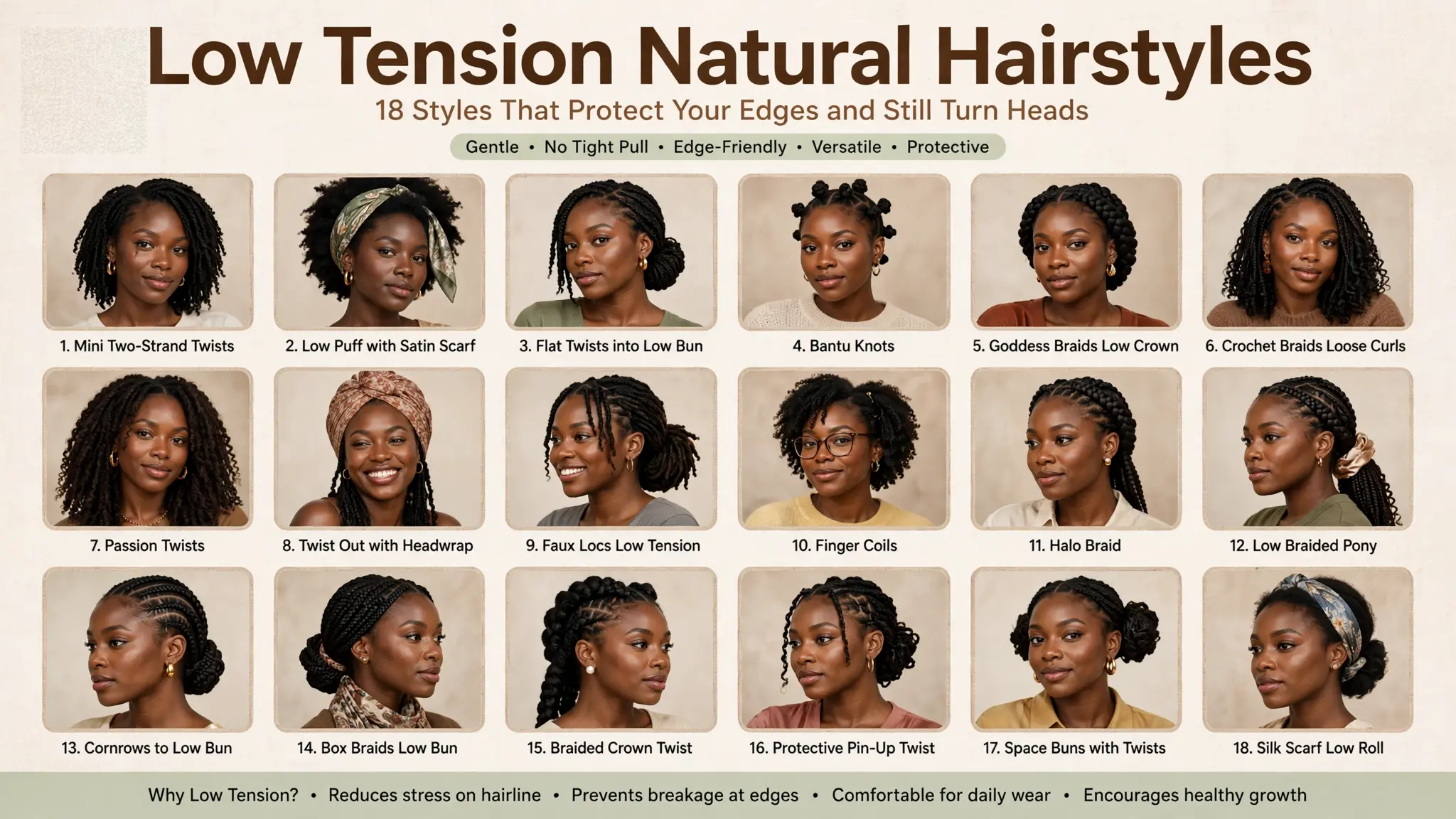
Low Tension Natural Hairstyles:18 Styles That Protect Your Edges and Still Turn Heads

If your scalp aches by lunch, your edges are tender, or you need a painkiller to sleep in a new install, the style is not protective. This guide ranks 18 low tension natural hairstyles by real scalp stress, tells you exactly how long each one can safely stay in, and shows you how to keep the tension low from install to takedown.
In short: Low tension means no pain, no pulling, no heavy added hair, and no style left in past its safe limit. The safest everyday options score 1 out of 5 for tension: a wash-and-go, a twist-out, a loose low bun, and a pineapple puff. Twists are the best balance of low tension and longevity. Braids and locs only count as low tension when they are knotless, lightweight, and removed on time. Full details, a one-page quick-pick table, and dermatologist-backed wear limits follow.
Save this guide before your next wash day. Every style below lists its tension score, how long it takes, how long it lasts, who it suits best, and the one mistake that quietly turns it into a high-tension style.
What low tension actually means for natural hair
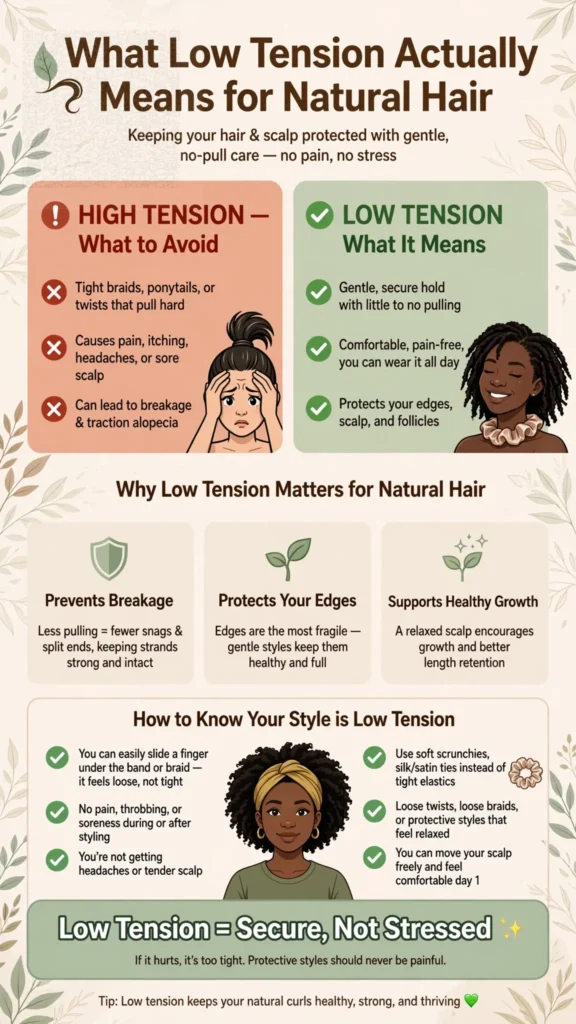
A low tension hairstyle is any style that does not pull, drag, or weigh down the hair follicle, especially at the hairline and temples where hair is finest and most fragile. Tension is not a feeling you should push through. It is mechanical stress, and repeated stress is the direct cause of traction alopecia, a form of hair loss that follows the pattern of the style itself: thinning edges, a receding hairline, small bumps around braids, and breakage where the hair is pulled tightest.
Dermatology research makes the risk plain. A widely cited review in the Journal of the American Academy of Dermatology by Haskin and Aguh at Johns Hopkins found that loose, low-hanging styles and loose updos carry low risk for traction alopecia, while tight braids, heavy extensions, and styles that cause pain carry high risk. The review advises keeping braided styles in for no longer than two to three months at the outer limit, removing weaves and extensions after six to eight weeks, and alternating styles so follicles can recover. Later guidance in this guide follows those limits, tightened further for fragile edges.
The four things that create tension
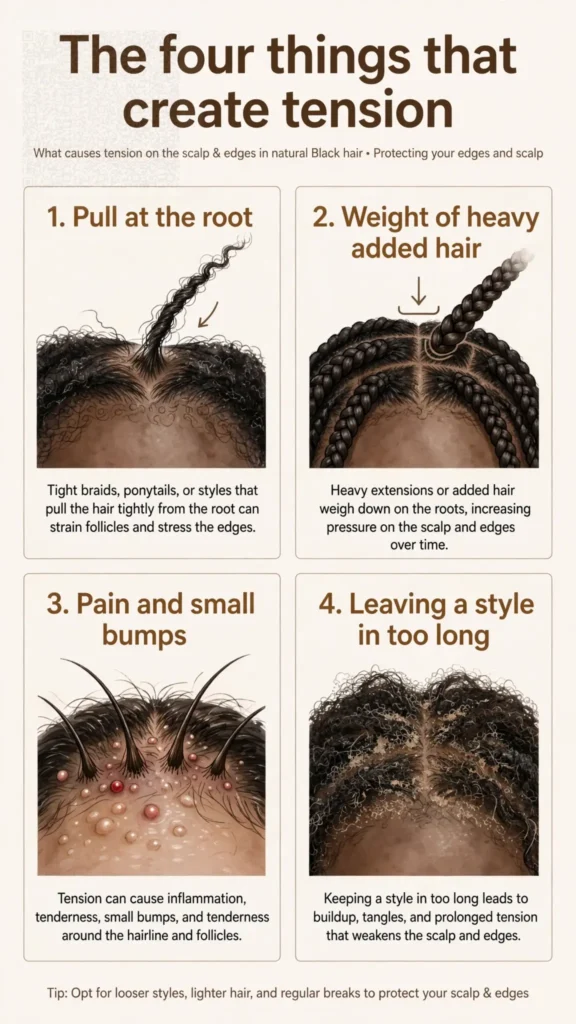
- Pull at the root. Slicked, stretched, or tightly gathered hair drags on the follicle all day. If you cannot comfortably raise your eyebrows, the gather is too tight.
- Weight. Long, heavy extensions hang from your own hair. The longer and heavier the added hair, the higher the stress, even if the install felt fine on day one.
- Pain and bumps. A tender scalp, headache, or small pimple-like bumps around parts are early warning signs. Pain is information, not a beauty tax.
- Time. Even a gentle style becomes a problem when new growth mats at the base and takedown turns into ripping. Every style has a safe expiry date.
| The 10-second test: On the day of install, you should be able to sleep comfortably, move your face freely, and touch your scalp without tenderness. If any of those fail, ask for the style to be loosened or taken down within 24 hours. Early traction alopecia is often reversible when the tension stops quickly. Once follicles scar over, regrowth in that spot may not return, which is why dermatologists treat pain as a stop signal, not a phase. |
How to use the tension scale in this guide
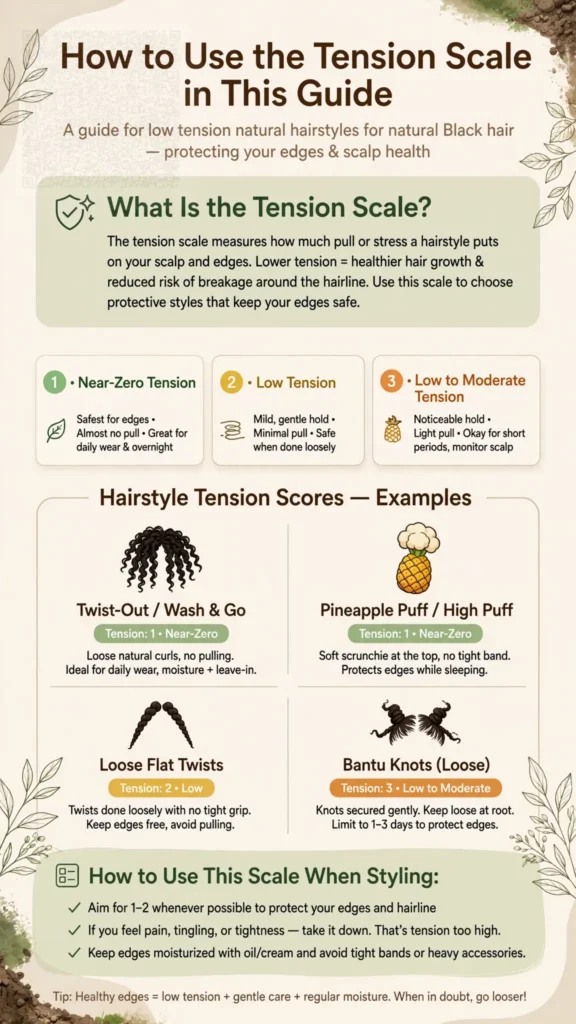
Every style is scored from 1 (lowest tension) to 5 (highest tension). The score assumes a correct, gentle install on moisturized hair. A careless install can push any style up one or two points, and the notes under each style name the exact error that does it.
- 1 — Near zero: No pulling, no added hair, scalp fully accessible. Safe for daily wear and for recovering edges.
- 2 — Low: Light gathering or loose twisting. Safe for most people, including sensitive scalps, with normal care.
- 3 — Low to moderate: Protective and worthwhile, but only with the right technique, light hair, and a firm removal date.
- 4 to 5: No style in this guide scores above 3 when done as described. If your version hurts, it has left the low-tension category.
Each entry also lists time to install, how long it lasts, and best for (hair length, texture, and lifestyle), so you can choose by your week, not just by a photo. Start with the table below, then read the full notes for your top two or three picks.
| For 4C and fine or fragile edges: Default to scores 1 and 2. Treat every score-3 style as an occasional option with a shorter wear time than the maximum listed, and keep added hair short and lightweight. |
A note on growth: no hairstyle speeds up how fast hair grows from the scalp. What low tension styles do is reduce breakage, so more of the length you grow stays on your head. That is called length retention, and it is the honest reason these styles help hair look longer over three to six months.
All 18 low tension styles at a glance
Pin or screenshot this table. Tension is scored 1 (lowest) to 5 (highest) for a gentle install. Lasts assumes satin protection every night.
| No. | Style | Tension | Install time | Lasts | Best for |
| 1 | Wash-and-go | 1 | 20–40 min | 3–5 days | All lengths, definition |
| 2 | Twist-out | 1 | 30–60 min + dry | 3–5 days | Medium–long, volume |
| 3 | Pineapple puff | 1 | 5 min | 1–3 days | Medium–long, busy days |
| 4 | Loose low bun | 1 | 5–10 min | 3–5 days | Work, formal, all lengths |
| 5 | Loose high bun | 2 | 5–10 min | 2–4 days | Medium–long, events |
| 6 | Claw-clip half-up | 1 | 3–5 min | 1–2 days | Short–medium, fragile edges |
| 7 | Chunky two-strand twists | 2 | 1–2 hours | 10–14 days | All lengths, beginners |
| 8 | Mini twists | 2 | 3–6 hours | 3–5 weeks | Length retention |
| 9 | Flat twists | 2 | 30–60 min | 5–10 days | Short–medium, under wigs |
| 10 | Flat-twist updo | 2 | 45–75 min | 7–10 days | Work, weddings |
| 11 | Bantu knots + knot-out | 2 | 30–45 min | 4–7 days | Short–medium, curl set |
| 12 | Halo crown braid | 2 | 20–40 min | 3–5 days | Medium–long, formal |
| 13 | Knotless braids, light | 3 | 4–7 hours | 4–6 weeks | Low daily styling |
| 14 | Loose cornrows | 2 | 30–90 min | 1–2 weeks | Under wigs, sport |
| 15 | Lightweight faux locs | 3 | 4–6 hours | 4–6 weeks | Long break from styling |
| 16 | Lightweight crochet | 2 | 1.5–3 hours | 4–6 weeks | Fast salon alternative |
| 17 | Headband or half wig | 1 | 5 min daily | Daily wear | Edge recovery, variety |
| 18 | Scarf and headwrap styles | 1 | 2–5 min | Daily | Bad-hair days, protection |
How to choose fast: need something today, pick 1 to 6. Need two or more weeks without daily styling, pick 7 to 12. Need a long break and accept salon time, pick 13 to 16 with the safety rules in their sections. Recovering your edges, live in 1, 2, 6, 17 and 18 until the hairline feels strong again.
Everyday styles with near-zero tension (Styles 1 to 3)
Three styles, no added hair, no appointment, scalp fully open to care. This is the safest rotation for thinning edges, tender scalps, and genuine rest weeks.
Style 1 — Wash-and-go (Tension 1/5)
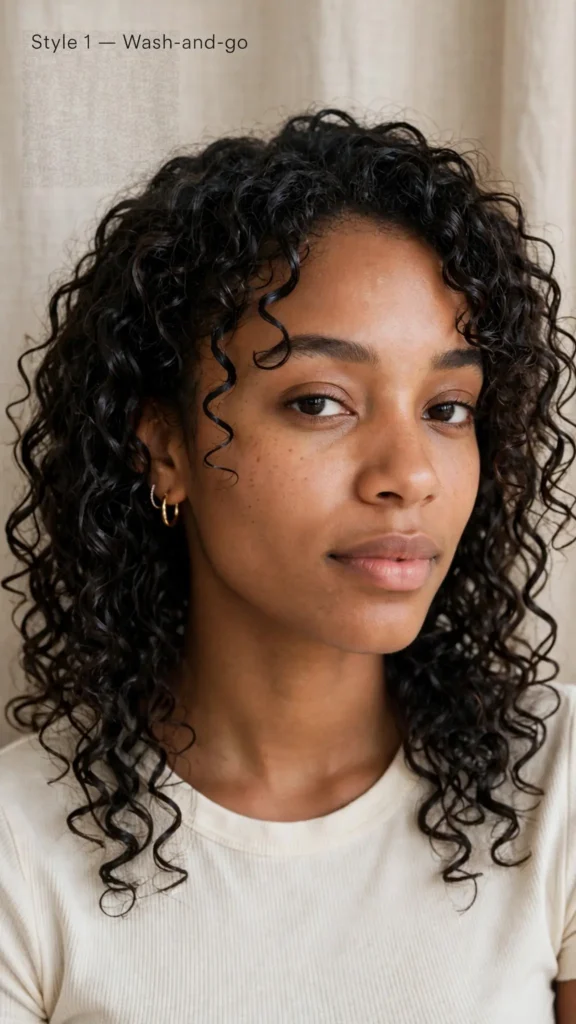
Install: 20 to 40 minutes | Lasts: 3 to 5 days | Best for: all lengths; defined curls without manipulation
Cleanse, condition, then apply leave-in and gel to soaking-wet hair in sections. Nothing is gathered or pulled, so tension stays near zero. Sleep in satin; refresh frizz with water and leave-in mist.
Keep it low tension: Detangle only wet, with conditioner.
Style 2 — Twist-out (Tension 1/5)
Install: 30 to 60 minutes plus drying time | Lasts: 3 to 5 days | Best for: medium to long hair; maximum volume
Twist moisturized hair, dry fully, then unravel with lightly oiled fingers. You get length, volume and curl pattern with almost no scalp stress, and the set twists double as a protective style the night before. Separate sparingly on day one to avoid frizz.
Keep it low tension: Twist on damp, conditioned hair; never pull roots flat for sharper parts.
Style 3 — Pineapple puff (Tension 1/5)
Install: 5 minutes | Lasts: 1 to 3 days; also the best overnight style | Best for: medium to long hair; gym, work, busy mornings
Gather curls loosely at the crown with a satin scrunchie. It preserves definition and saves a wash-and-go overnight.
Keep it low tension: Always use satin: a bare elastic snaps fine hairline hair, and the damage adds up.
Polished updos that do not punish your hairline (Styles 4 to 6)
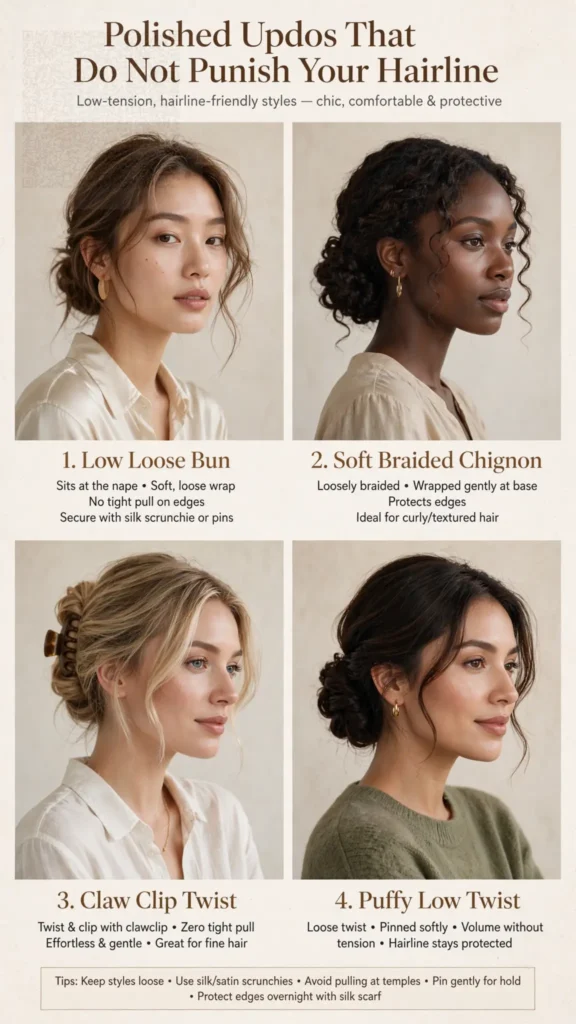
A bun is only high tension when slicked and stretched tight. Loose and low, these updos are among the safest here, and formal enough for work and weddings.
Style 4 — Loose low bun (Tension 1/5)
Install: 5 to 10 minutes | Lasts: 3 to 5 days with nightly satin | Best for: all lengths with enough hair to gather; the safest formal style
Gather moisturized hair low at the nape with a satin scrunchie. Low placement works with gravity, and tucked ends escape collar friction. For fullness on shrunken hair, twist the night before and gather stretched hair in the morning.
Keep it low tension: Keep the hairline soft, skip daily hard-gel edge brushing, and vary part and position through the week.
Style 5 — Loose high bun and soft updos (Tension 2/5)
Install: 5 to 10 minutes | Lasts: 2 to 4 days | Best for: medium to long hair; events and photos
A high bun photographs beautifully but drags upward, adding a point of tension. Gather loosely, pin rather than wrench, leave soft tendrils, and place cuffs through the bun, never through roots.
Keep it low tension: Occasion style only; take it down if a headache starts.
Style 6 — Claw-clip half-up and soft pinned updos (Tension 1/5)
Install: 3 to 5 minutes | Lasts: 1 to 2 days | Best for: short to medium hair; fragile or recovering edges
Clip the top gently and leave the rest free. A claw clip holds without squeezing, and the hairline does no work. Live in this while edges recover, shifting position slightly each day so no spot is stressed twice.
Keep it low tension: Shift the clip position slightly each day so no spot is stressed twice.
Twist-based protective styles (Styles 7 to 9)
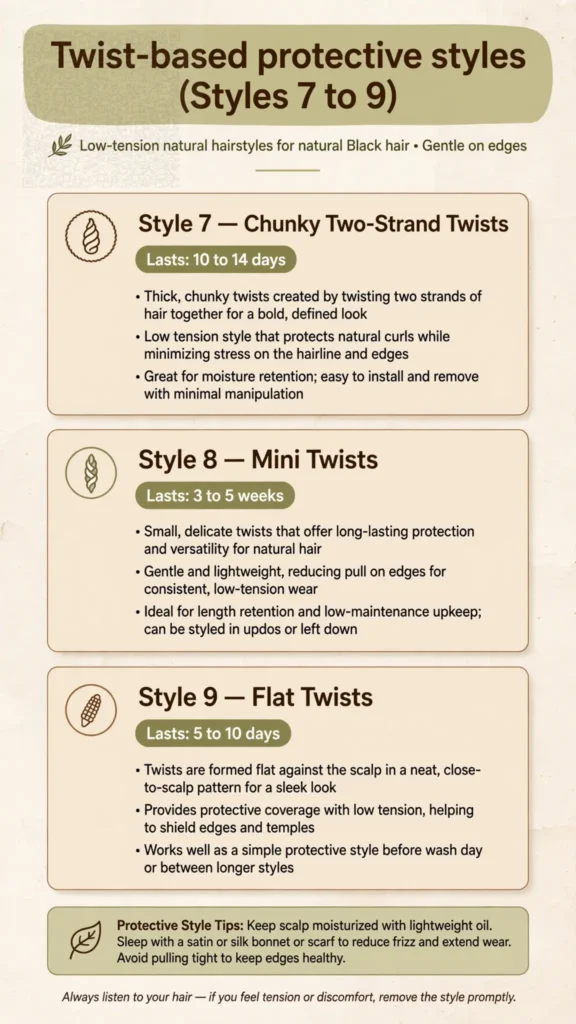
Twists are this guide’s sweet spot: protective, edge-kind, and doable at home. One rule governs all of them: twist the hair, not the scalp. Roots should sit comfortably and relax within two days.
Style 7 — Chunky two-strand twists (Tension 2/5)
Install: 1 to 2 hours | Lasts: 10 to 14 days | Best for: beginners; all lengths; the best first protective style
On washed, deep-conditioned hair, layer leave-in, light oil, then twisting cream (the LOC method) so moisture reaches the strand. Twist at about 80 percent dry. With satin nightly, twists last up to two weeks, then unravel into a twist-out.
Keep it low tension: Never twist dry hair; keep perimeter twists loosest.
Style 8 — Mini twists (Tension 2/5)
Install: 3 to 6 hours | Lasts: 3 to 5 weeks | Best for: length retention; styling variety on natural hair alone
Mini twists cost hours once, then repay for weeks: wear loose, clipped, or in updos without re-installing. With no extension weight, moisturizing and takedown stay gentle. Cleanse parts every one to two weeks; mist lightly.
Keep it low tension: Avoid micro twists at the hairline; go larger at the edges.
Style 9 — Flat twists (Tension 2/5)
Install: 30 to 60 minutes | Lasts: 5 to 10 days | Best for: short to medium hair; neat base under wigs
Flat twists give cornrow sleekness with less pull, as two strands roll rather than braid under tension. Wear as a style or set for a twist-out. Keep parts clean, not forced, and add moisture rather than pulling dry hair flat.
Keep it low tension: Keep parts clean, not forced; add moisture rather than pulling dry hair flat.
Twists dressed up: updos, knots and crowns (Styles 10 to 12)
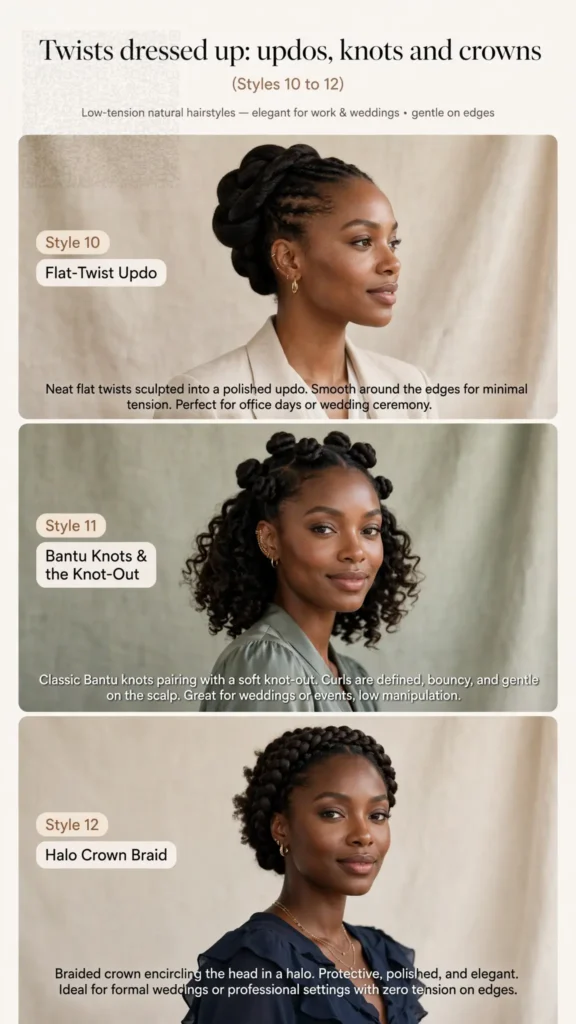
Style 10 — Flat-twist updo (Tension 2/5)
Install: 45 to 75 minutes | Lasts: 7 to 10 days | Best for: work, weddings, and anyone who wants polish without a salon
Twist sides and back upward; pin ends into a bun or roll, anchoring into the twist, not tight roots. Stretch hair the night before for smoothness without day-of pulling. Satin at night keeps you waking styled, not flattened.
Keep it low tension: Anchor pins into the twist, not into tight roots.
Style 11 — Bantu knots and the knot-out (Tension 2/5)
Install: 30 to 45 minutes | Lasts: 4 to 7 days as knots; overnight as a curl set | Best for: short to medium hair; two looks from one install
Section evenly, twist, coil each twist around itself and tuck. Even sections give an even knot-out. Wear knots as a sculptural protective style, or unravel after a day for defined heat-free curls.
Keep it low tension: Knots sit flat without tenderness; hairline knots loosest.
Style 12 — Halo crown braid (braided crown) (Tension 2/5)
Install: 20 to 40 minutes | Lasts: 3 to 5 days | Best for: medium to long hair; formal events, work, hot weather
Two braids wrapped around the head tuck every end off the neck, reading formal from office to wedding. Braid stretched, moisturized hair; pin under the braid. Skip fresh flowers (they wilt against the scalp); fabric flowers photograph the same. Mist, cover with satin, lasts days.
Keep it low tension: Braid on stretched, moisturized hair and pin under the braid.
Two looks in one: knots today, curls tomorrow
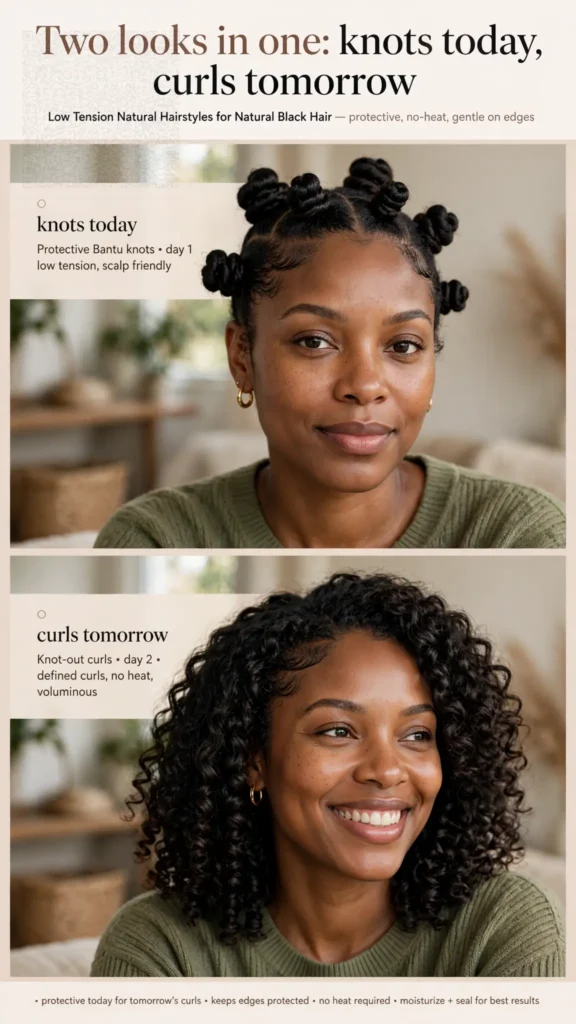
Bantu knots deserve a closer look because no other style in this guide works as both a finished protective style and a setting tool. On wash day, install knots on moisturized hair and wear them as they are: graphic, neat, and completely off the face, with every end sealed inside its own coil. Sleep in a satin scarf to keep the coils smooth.
The next morning, or after four to seven days, unravel each knot slowly with lightly oiled fingers. What emerges is a stretched, defined curl set achieved with no heat and no rods. Separate gently and arrange with your fingers rather than a brush. The result rivals a rod set, and because the hair was protected inside the knots while it set, it starts the week moisturized instead of dried out by styling.
| Stylist note from our testing: Section size decides everything. Eight to twelve even sections give uniform knots and an even knot-out. One oversized section among small ones will unravel into a visibly different curl, and no amount of picking fixes it. Count your sections before you start. |
The same two-for-one logic applies across this guide. Flat twists become a twist-out. Chunky twists become a twist-out. A stretched low bun becomes loose, elongated curls when released. Choosing styles that convert means fewer installs, less manipulation, and longer stretches between wash days, which is precisely how length gets retained.
Braids and locs, done the low-tension way (Styles 13 to 15)
Braids and locs are not automatically protective. They earn the label only with the right technique, the right weight of hair, and a removal date you actually keep. Done as described below, they score 2 to 3. Done tight and heavy, they are the most common cause of the edge loss this guide exists to prevent.
Style 13 — Knotless box braids, lightly installed (Tension 3/5)
Install: 4 to 7 hours | Lasts: 4 to 6 weeks maximum | Best for: a long break from daily styling; medium parts only
Knotless braids start with your own hair and feed extensions in gradually, so there is no tight anchor knot dragging on the root. Choose medium or larger parts, moderate length, and lightweight hair, and say the sentence that protects your edges at the salon: I want them loose, with no pulling at the hairline. Cleanse the scalp every one to two weeks and moisturize two to three times a week. Remove by six weeks, sooner if edges feel tender.
Keep it low tension: Medium or larger parts, moderate length, lightweight hair; remove by six weeks.
Style 14 — Loose cornrows (Tension 2/5)
Install: 30 to 90 minutes | Lasts: 1 to 2 weeks | Best for: under wigs and scarves; sport; a flat, breathable base
Straight-back or simple patterned cornrows braided without tension let you reach the scalp daily for cleansing and moisture, which is why they remain a staple base style. Leave edges out of perimeter cornrows, or braid those rows noticeably looser. A cornrow that throbs is not a base; it is a problem worn under a wig where you cannot see it.
Keep it low tension: Leave edges out of perimeter cornrows, or braid those rows noticeably looser.
Style 15 — Lightweight faux locs (Tension 3/5)
Install: 4 to 6 hours | Lasts: 4 to 6 weeks, six is the limit | Best for: the longest low-manipulation break
Faux locs give weeks of zero daily styling, but weight decides their safety. Lightweight synthetic hair and small, not overstuffed sections keep root stress low; heavy hair on fine strands creates exactly the traction dermatologists warn against. Spray the scalp between locs twice a week, sleep in satin every night, and budget for removal at six weeks without exception. Beyond that, new growth mats against the base and takedown becomes a breakage event.
Keep it low tension: Lightweight hair only; removal at six weeks without exception.
Fast coverage without the pull (Styles 16 to 18)
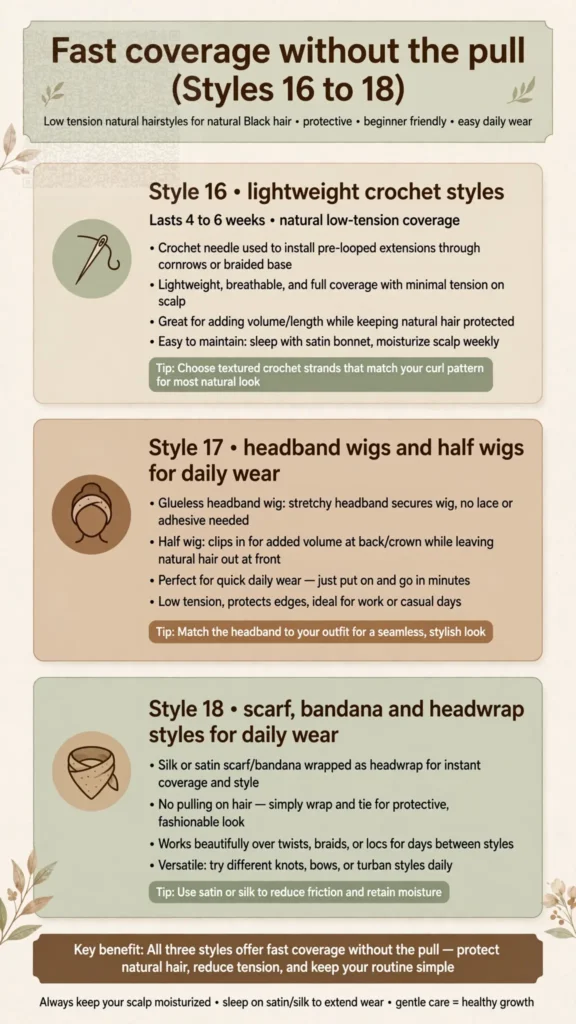
Style 16 — Lightweight crochet styles (Tension 2/5)
Install: 1.5 to 3 hours | Lasts: 4 to 6 weeks | Best for: salon look, half the chair time of braids
Crochet latches pre-looped hair onto loose cornrows: braids, twists or curls in half the chair time, with less tension if the base is loose and hair light. Cleanse regularly, refresh with leave-in, and remove by six weeks even if it still looks good.
Keep it low tension: The base decides: loose cornrows and light hair only.
Style 17 — Headband wigs and half wigs (Tension 1/5)
Install: 5 minutes daily over loose twists or cornrows | Lasts: daily wear; wash the unit as directed | Best for: edge recovery; instant variety
Over loose twists or cornrows, a headband or half wig rests your hair completely while you change looks at will. Use a satin-lined cap; cotton rubs the hairline raw. Hair underneath still needs cleansing, conditioning and moisture, plus scalp air between wears. Never sleep in a wig.
Keep it low tension: Use a satin-lined cap and never sleep in a wig.
Style 18 — Scarf, bandana and headwrap styles (Tension 1/5)
Install: 2 to 5 minutes | Lasts: daily | Best for: failed wash days, deep-conditioning days, sun and friction protection
A satin scarf tied clear of the hairline is a real style: it shields hair from sun, headrests and winter fabrics, and protects tomorrow’s style.
Keep it low tension: Tie at side or back, satin against hair, never cotton, which steals moisture overnight.
The low-tension rules: install, night and takedown
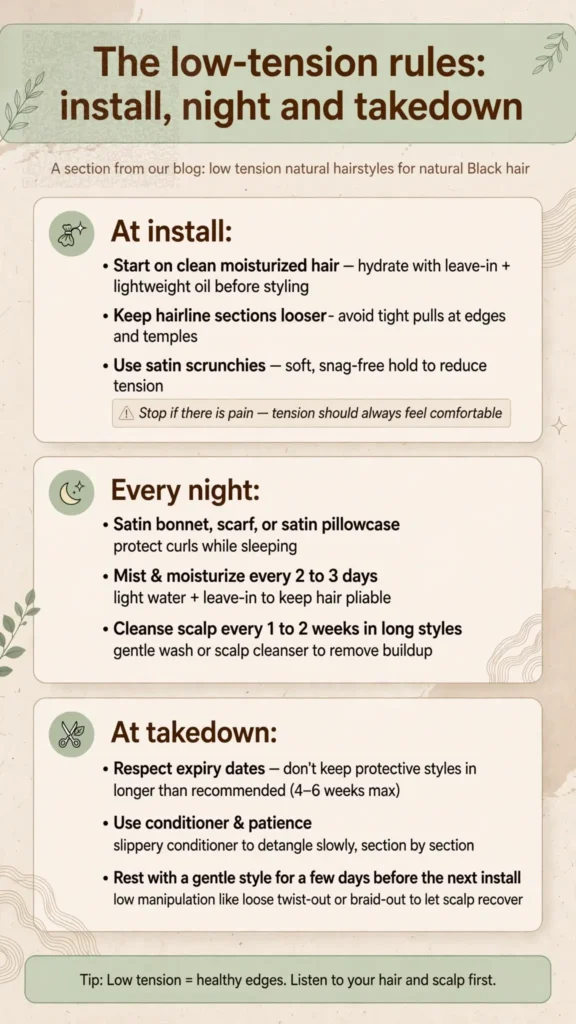
The style you pick is only half the protection. These habits decide whether any style in this guide stays low tension for its full life.
At install
- Start on clean, deep-conditioned, moisturized hair. Installing on dry hair locks in dryness for the life of the style.
- Say your tension limit out loud to your stylist, and mean it. A good stylist loosens without argument. Pain, bumps, or inability to move your eyebrows means stop and redo that section.
- Keep hairline sections larger and looser than the rest of the head. Edges are the finest hair you own.
- Choose satin scrunchies, fabric elastics, pins and clips. Never a bare rubber band directly on natural hair.
Every night and every week
- Satin or silk bonnet, scarf, or pillowcase every night, without exception. This single habit is the difference between a day-one style and a day-four style.
- Mist with water, then seal with leave-in or a light oil every two to three days, or as your texture demands. A style that looks fine outside can be straw-dry underneath.
- Cleanse the scalp every one to two weeks in braids, twists, or locs: diluted shampoo in a spray bottle applied to the parts, gentle massage, rinse, then light oil.
- Alternate positions and styles. Move the bun, change the part, and give the hairline full rest weeks between long installs.
At takedown
- Honour the expiry date: twists at two to five weeks by size, braids, locs and crochet at six weeks maximum, cornrows at two weeks.
- Take down with conditioner, water, and patience, detangling in sections. Rushing takedown undoes months of retention in one evening.
- Wash, deep-condition, and wear a score-1 style for at least a few days before the next install. Follicles need recovery time, not just your strands.
| When to see a dermatologist: Thinning that keeps spreading after tension stops, smooth shiny patches with no visible follicles, persistent bumps, pain, or scaling. Early traction alopecia often regrows once tension ends; scarring alopecia does not, so do not wait out warning signs. This guide is styling guidance, not medical advice. |
Five mistakes that turn a low-tension style high-tension
- The headache install. Tight on day one never relaxes into healthy by day three. It just injures quietly for longer. Loosen or remove within 24 hours.
- Heavy hair on fine strands. Length and density of extensions matter more than brand. If in doubt, go shorter, larger parts, lighter hair.
- The glued-flat hairline. Daily hard gel and brushing to lay edges creates constant traction exactly where hair is weakest. Keep edges soft on most days.
- The forever style. Eight weeks becoming twelve because it still looks neat is how new growth mats and takedown breaks hair. Put the removal date in your calendar at install.
- The dry install and the thirsty middle. Twisting dry hair, then never moisturizing inside the style, guarantees breakage no matter how loose the roots are.
Frequently asked questions
What is the lowest-tension hairstyle for natural hair?
A wash-and-go, a twist-out, a pineapple puff with a satin scrunchie, and a loose low bun all score 1 out of 5. Nothing is gathered tightly, no hair is added, and the scalp stays accessible for cleansing and moisture. For recovering edges, rotate among these plus claw-clip half-ups, headband wigs, and scarves.
Do low tension styles help hair grow?
They help hair retain length, which looks like growth over time. Hair grows from the scalp at its own rate regardless of style. Low tension styles reduce breakage at the ends and hairline, so more of that growth stays on your head instead of snapping off. Expect to judge retention over three to six months, not three weeks.
How long can I keep braids, twists or faux locs in?
Keep chunky two-strand twists up to two weeks, mini twists three to five weeks, and cornrows one to two weeks. Keep knotless braids, faux locs and crochet styles for four to six weeks, with six weeks as the absolute limit. Johns Hopkins dermatology guidance allows braided styles up to two to three months at the outermost limit, but for fragile edges and length retention, the shorter limits in this guide are safer. Always remove sooner if there is pain, bumps, or matting.
Are knotless braids really low tension?
Only when they are installed lightly, with medium or larger parts, moderate length, and lightweight hair. Knotless technique removes the tight anchor knot, which helps, but heavy, waist-length hair on fine edges is still high tension by weight. Tension score in this guide: 3 out of 5, the highest of any style listed, so treat them as an occasional style with full rest weeks between installs.
Which low tension style is best for 4C hair and thinning edges?
Start with score-1 styles: wash-and-go, twist-out, loose low bun, pineapple puff, and claw-clip half-up. Add chunky two-strand twists and flat twists (score 2) once the hairline feels comfortable. Keep edges out of braids and twists entirely during recovery, moisturize daily, sleep in satin, and avoid hard edge gels. If thinning spreads or you see smooth, shiny patches, see a dermatologist promptly.
How do I keep a low tension style moisturized?
Mist lightly with water, smooth on leave-in conditioner, and seal with a small amount of light oil every two to three days, focusing on ends and any dry sections. In braids, twists, or locs, cleanse the scalp every one to two weeks with diluted shampoo sprayed onto the parts. Cover hair with satin every night. Moisture inside the style matters as much as the style itself.
Can I wear a low bun or puff every day?
Yes, if you vary the position, use satin scrunchies, keep the hairline soft, and take the style down regularly to moisturize and let the scalp rest. Repeating the exact same stressed point daily is the risk, not the bun itself. Move the bun from low to side to crown across the week and alternate with loose styles.
Wear the style. Do not let the style wear you.
Low tension is not a single hairstyle. It is a rotation: gentle installs, satin nights, honest expiry dates, and rest weeks where your hairline does no work at all. Pick two styles from the table that fit your length and your calendar, learn to install them loosely, and let retention do its slow, visible work. Your edges will tell you the truth about every style within a day. Listen the first time.
Found your next style? Save this guide on Pinterest so it is waiting for you on wash day, and explore more natural hair care and protective styling ideas at HairInspoHub.

Stella Mary is a US-based hair care enthusiast and lifestyle writer at HairInspoHub, sharing trend-forward hairstyle tutorials, styling tips, and healthy hair rituals for women of every hair type. Specializing in Pinterest-inspired looks from bridal updos and effortless braids to heatless waves and sleek ponytails. She blends timeless elegance with everyday practicality. Her mission making gorgeous, confidence-boosting hairstyles accessible to everyone, one tutorial at a time.