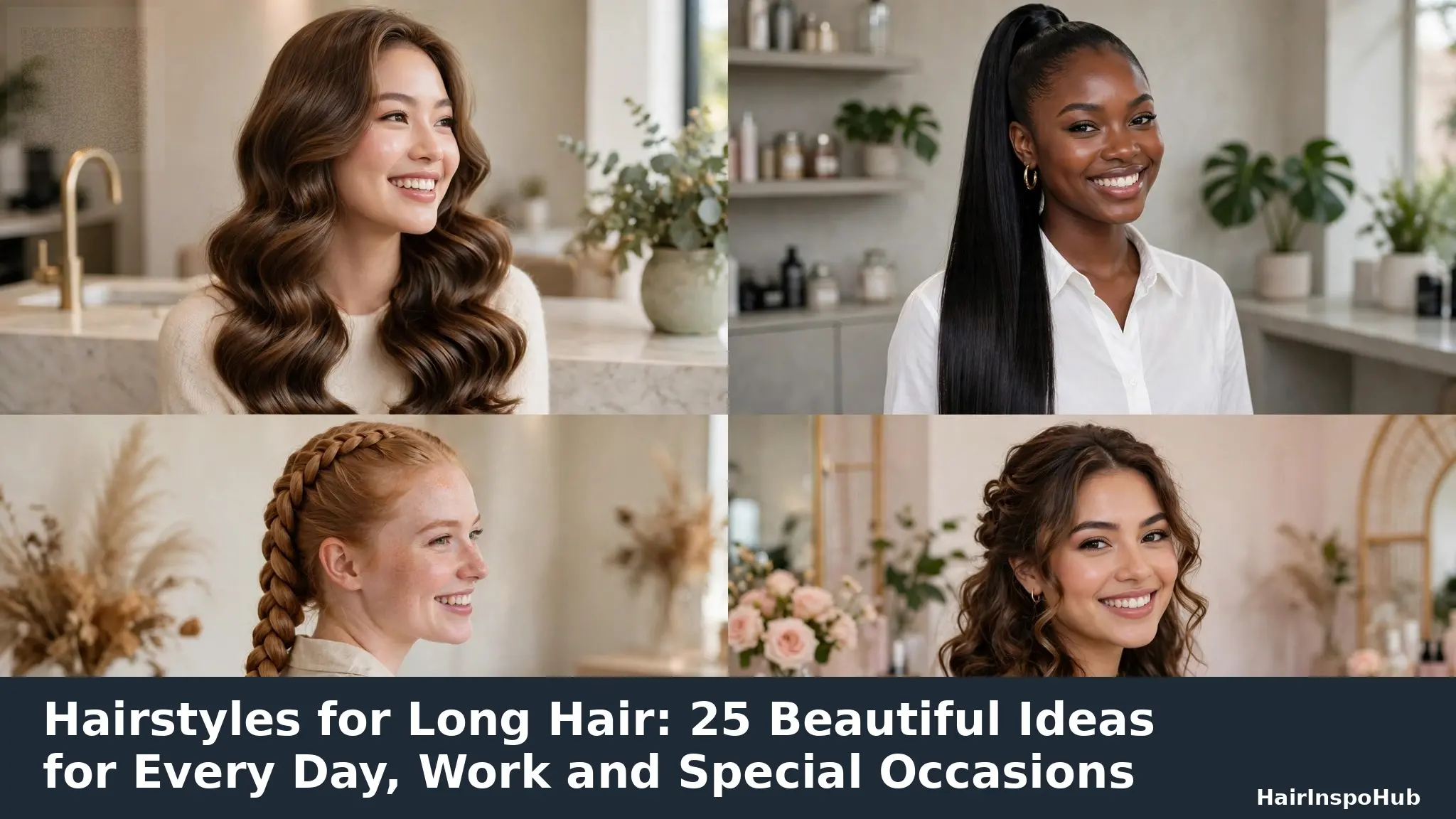
Hairstyles for Long Hair: 25 Beautiful Ideas for Every Day, Work and Special Occasions

Long hair is not hard to style. Long hair is hard to choose for. You have length, weight and options, so most mornings end in the same ponytail or the same loose waves, even though the hair in front of you could do twenty-five different things.
This guide fixes the choosing problem first. You will first pick by occasion and time, then by hair type and skill, then open only the two or three hairstyles that fit your day. Each idea gives you the time it takes, the skill level, short steps that work on real long hair (not a two-minute wig demo), and the one hold tip that stops long hair doing what long hair always does: falling flat, slipping out, or tangling by lunch.
A note on length and health, because both change the answer: these styles assume hair past the shoulders. The longer and heavier your hair is, the more every updo needs a real anchor (a small elastic first, pins second) and the less a style can rely on hairspray alone. And no style below asks you to pull tight at the hairline every day. Repeated tight tension is a known cause of breakage and traction hair loss at the edges, so the secure versions here spread the hold across elastics, clips and braids instead.
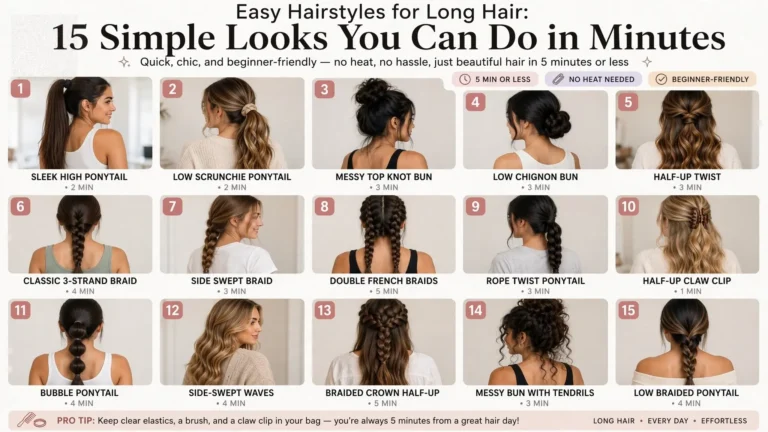
If you only have 2 to 10 minutes, start with our easy hairstyles for long hair routine guide. This page is the bigger inspiration library: everyday, work, gym, party, wedding-guest and heat-free looks, all in one place.
Quick answer: what are the best hairstyles for long hair?
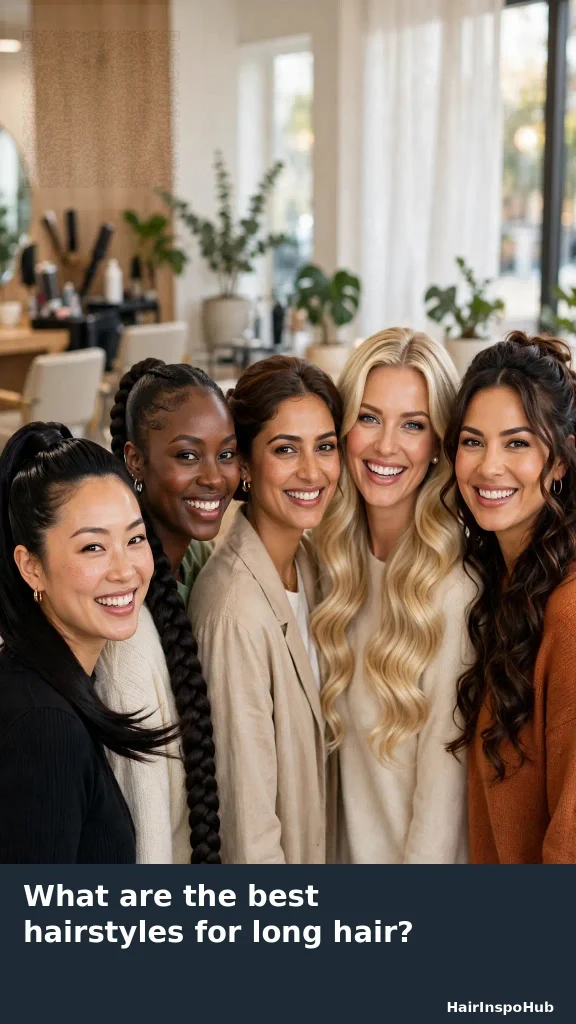
The best hairstyles for long hair are the ones your length does better than short hair can: a high or low ponytail with real swing, a French or fishtail braid that uses the full length, a low chignon that hides its pins in the weight of the hair, Hollywood waves brushed out over the shoulders, and a half-up style that shows the length off while keeping hair out of your face. Start with these five, then choose by day:
- Fastest everyday: messy bun with face-framing tendrils, bubble ponytail, or claw-clip half-up (5 minutes or less).
- Most polished for work: sleek low ponytail, low chignon, or smooth blowout layers with a centre part.
- Best without heat: overnight braid waves, a rope-braid bun, or a twisted half-up on air-dried hair.
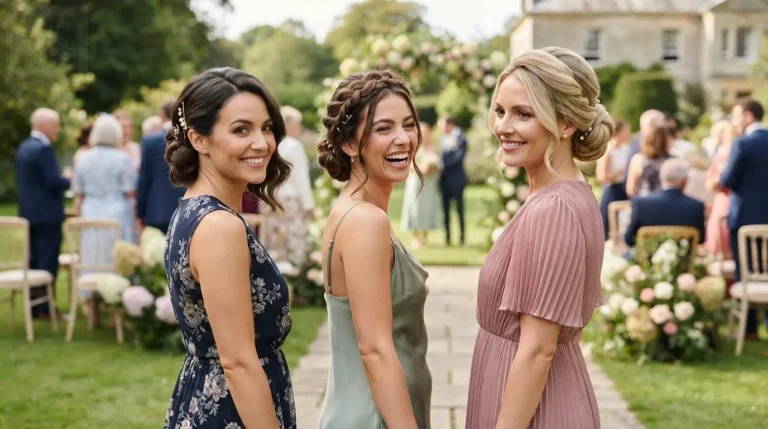
- Best for a party or wedding guest: Hollywood waves, a half-up curled style with a braid detail, or a low chignon with pearl pins.
- Best for the gym and hot days: Dutch double braids, a braided high ponytail, or a top knot anchored with an elastic first.
- Most protective: a loose single braid, a low bun on a silk scrunchie, or long twists worn for days, never pulled tight at the edges.
Hairstyles for long hair at a glance
| Your situation | Start with these | Why they work |
| School or office morning, 5 minutes | Claw-clip half-up (6), bubble ponytail (11), messy bun (13) | Fast, no heat, hides second-day roots |
| Work meeting or interview | Low chignon (14), sleek low ponytail (12), glass-straight centre part (2) | Smooth outline, nothing falling in the face |
| Date or dinner | Hollywood waves (1), half-up twisted crown (7), side fishtail (19) | Soft movement, length on show |
| Party, prom or wedding guest | Half-up curls with braid (9), French twist (15), Hollywood waves (1) | Holds for hours, photographs well |
| Gym, run or hot weather | Dutch double braids (18), top knot (16), braided ponytail | Fully off the neck, survives movement |
| No-heat day | Braid waves (3), pull-through braid (20), twisted half-up (7) | Style is created by the braid or twist, not a tool |
| Fine, flat long hair | Blowout layers (4), bubble ponytail (11), half-up high pony (8) | Creates the illusion of thickness and lift |
| Thick, heavy long hair | Low chignon (14), French braid (17), crown braid updo (21) | Distributes weight instead of fighting it |
| Natural curls and coils | Defined curls down (22), pineapple-friendly half-up (7), long twists (23) | Works with the pattern, minimal tension |
How to choose a long hairstyle in 30 seconds
Choose by time first
Be honest about the clock. A style that needs 25 minutes will not happen on a weekday, however beautiful the photo is. Every idea below lists a real time for long hair, including brushing and securing, and the quick-pick table is sorted so the five-minute styles come with their own section later. Long hair adds minutes at three points people forget: detangling, sectioning, and pinning enough to carry the weight.
Choose by skill, not by photo
Beginner styles use one elastic or one clip and gravity does the rest. Intermediate styles need one repeated motion, like a braid rhythm or a curling direction. Advanced styles combine two skills, for example braiding plus pinning an updo. If a style is new, try it once on a no-pressure evening. Hairstyles are motor skills; the second attempt is always twice as fast.
Choose by what your hair is doing today
Freshly washed long hair is slippery and needs texture spray or a day of patience for updos. Second-day hair grips braids and buns better and is the best base for most styles here. Curly and coily hair should be styled on its own rhythm, detangled gently when wet and conditioned, never brushed dry before styling. Fine hair needs lightness at the roots and should avoid heavy oils before an up style; thick hair needs the opposite, enough slip to section cleanly and stronger elastics that will not snap.
What you need before you start (the long-hair kit)
| Item | Why long hair needs it | Budget note |
| Wide-tooth comb and a soft bristle brush | Detangles lengths without snapping them; brush is for smoothing ponytails and buns | One of each lasts years |
| No-metal elastics in two sizes | Metal joints catch and break long strands; large size carries thick ponytails | Replace when they stretch out |
| Silk or satin scrunchies | Night styles and loose buns without creases or edge tension | Two is enough to rotate |
| Claw clip, large | Half-up styles on long hair need a clip that can actually hold the top section | Choose based on thickness, not colour |
| Bobby pins and U-pins | Pins carry buns; U-pins hold chignons without flattening them | U-pins are the updo upgrade most people miss |
| Heat protectant | Non-negotiable before any iron or wand on lengths you spent years growing | One bottle covers all heat styles here |
| Texture or sea-salt spray | Gives slippery long hair the grip braids and buns need | Light mist, not a soaking |
| Light hair oil or serum, ends only | Seals the oldest, driest part of long hair and calms flyaways | Pea-sized amount; roots stay clean |
Quick-pick table: all 25 hairstyles for long hair
Time is for practised hands on past-shoulder hair. Add five minutes the first time you try any style.
| # | Hairstyle | Best for | Time / skill |
| 1 | Hollywood waves | Party, photos, date | 25-35 min / intermediate |
| 2 | Sleek glass-straight, centre part | Work, evening polish | 20-30 min / intermediate |
| 3 | Heatless overnight braid waves | No-heat everyday waves | 10 min + overnight / beginner |
| 4 | Voluminous blowout layers | Fine or flat long hair | 20-25 min / intermediate |
| 5 | Defined curls, worn down | Natural curls, big occasions | 30-45 min / intermediate |
| 6 | Half-up claw-clip style | Everyday, second-day hair | 3-5 min / beginner |
| 7 | Half-up twisted crown | Soft everyday, curly hair | 8-10 min / beginner |
| 8 | Half-up high ponytail | Lift and face-framing length | 7-10 min / beginner |
| 9 | Half-up curls with braid detail | Prom, wedding guest | 25-35 min / intermediate |
| 10 | High sleek ponytail with wrap | Work to evening, hot days | 10-12 min / beginner |
| 11 | Bubble ponytail | Fun everyday, fine hair volume | 6-8 min / beginner |
| 12 | Low ponytail with scarf or ribbon | Polished casual, bad-hair save | 5 min / beginner |
| 13 | Messy bun with tendrils | Everyday default, second-day | 5 min / beginner |
| 14 | Low chignon / sleek low bun | Weddings, interviews, formal | 12-15 min / intermediate |
| 15 | French twist | Classic formal updo | 15-20 min / intermediate |
| 16 | Top knot / ballerina bun | Gym, heat, tall clean look | 6-8 min / beginner |
| 17 | Classic French braid | All-day hold, active days | 10-12 min / intermediate |
| 18 | Dutch double braids | Sport, festivals, protective | 15-20 min / intermediate |
| 19 | Side fishtail braid, pancaked | Romantic, photos | 12-15 min / intermediate |
| 20 | Pull-through braid (beginner braid) | Braid look without braiding | 10 min / beginner |
| 21 | Crown braid updo (milkmaid) | Formal, thick hair updo | 20-25 min / advanced |
| 22 | Defined natural curls with side part | Curly and coily long hair | Wash-day / intermediate |
| 23 | Long twists (protective style) | Multi-day protective wear | Salon or long home session |
| 24 | Loose waves with pearl or bow accessory | Party upgrade in 2 minutes | 15-20 min / beginner |
| 25 | Braided high ponytail | Gym-to-out, secure swing | 10-12 min / intermediate |
1. Hollywood waves
Best for: Party, photos and any dress that deserves brushed-out glamour.
Time and skill: 25-35 minutes, intermediate
Curl large sections away from the face with a wide-barrel iron, keeping the ends smoother than the mid-lengths. Let every curl cool completely before touching it; warm curls dropped early are why waves fall flat on long hair. Brush through gently with a soft brush so the curls join into waves, then mist lightly. The length does the work here: waves need room to form an S shape, which is why this style flatters long hair more than any other. Keep the part slightly off-centre for a softer, modern finish.
Hold tip: Cooling time is the hold. Clip each curl up while it cools if your hair drops curls quickly.
2. Sleek glass-straight hair with a centre part
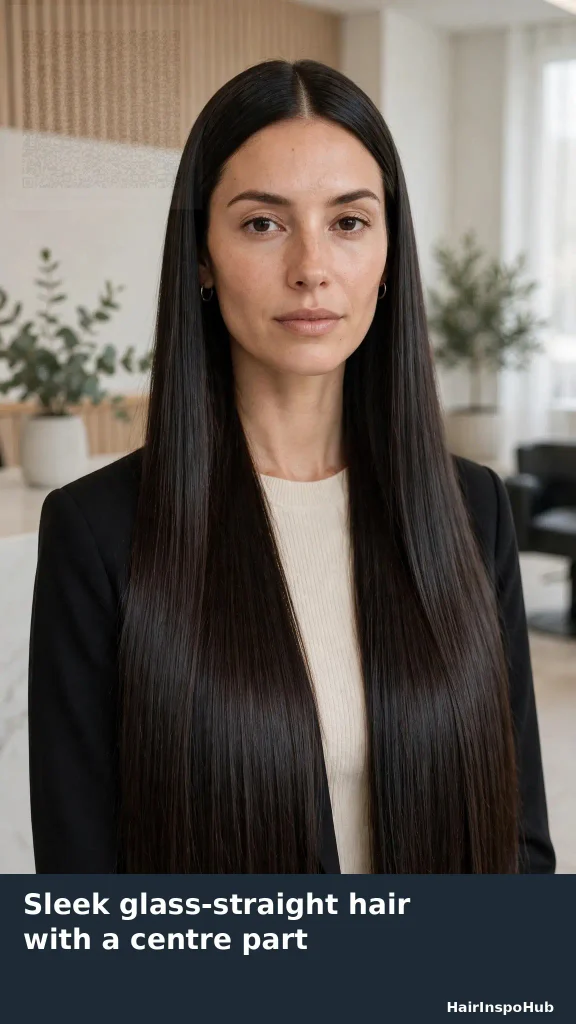
Best for: Work polish, evening minimal looks, and showing off a fresh trim.
Time and skill: 20-30 minutes, intermediate
Straighten in thin sections from underneath upward, one slow pass rather than three fast ones. Run a pea-sized amount of serum through the ends only. A centre part makes this style: check it in a mirror so the line is clean from forehead to crown. On long hair, straight styles fail at the back, so finish by brushing all the hair forward over the shoulders and checking both sides match. This is the best style for showing a blunt or U-shaped hemline.
Hold tip: Thin sections matter more than heat. Thick sections ironed fast stay puffy inside and sleek outside for one hour only.
3. Heatless overnight braid waves
Best for: Everyday waves with zero heat, and the healthiest regular style on this list.
Time and skill: 10 minutes at night, beginner
On slightly damp, detangled hair, apply a small amount of leave-in or mousse and braid one loose French braid (softer waves) or two braids (tighter waves). Sleep on a satin pillowcase if you can. In the morning, undo gently, shake at the roots with your fingers, and do not brush. Because the wave is set by the braid rather than a tool, it lasts on long hair that usually drops heat curls by midday. Scale the braid count to your thickness: very thick hair may need three braids for even waves.
Hold tip: Braids too tight make crimps, not waves. You should be able to slide a finger under the braid.
4. Voluminous blowout layers
Best for: Fine or flat long hair, fresh-haircut days, camera days.
Time and skill: 20-25 minutes, intermediate
Blow-dry with a large round brush, lifting each section up and away from the scalp before rolling it down. Set the top sections in the brush to cool, or pin them for two minutes. The style is built for layered long hair: the layers flip and stack, giving width at the sides that one-length hair cannot copy. If your hair is one length, you will still get root lift and smooth ends, just less flip. Finish with the cool shot if your dryer has one; heat shapes hair, cooling sets it.
Hold tip: Dry the roots first and the ends last. Wet roots under dry ends collapse within the hour.
5. Defined curls, worn down
Best for: Naturally wavy to curly hair, big occasions, maximum length on show.
Time and skill: 30-45 minutes, intermediate
Work in sections no wider than two fingers. For natural curls, apply curl cream on soaking-wet hair, scrunch, and dry with a diffuser without touching. For wand curls on straighter hair, curl in one direction per side and leave the curls unbrushed for a polished ringlet finish, or brush once for softness. Long curls weigh themselves straighter at the root, so clip the roots while drying if you want lift at the crown as well as curl at the ends.
Hold tip: Touch is the enemy while curls dry. Every scrunch after the first adds frizz, not definition.
6. Half-up claw-clip style
Best for: Everyday wear, second or third-day hair, growing-out fringes.
Time and skill: 3-5 minutes, beginner
Gather the top section from the temples to the crown, twist it once, and clip it at the back with a large claw clip. Pull two slim tendrils out at the front. This is the fastest face-lifting style for long hair because the clip does the holding and the length does the showing off. On very thick hair, make a small ponytail with a thin elastic first, then clip over it; the clip alone will otherwise slide down by midday.
Hold tip: Clip size is the whole decision. If the clip cannot close over the section in your hand, it will not hold in your hair.
7. Half-up twisted crown
Best for: Soft everyday looks, curly and wavy hair, no-elastic days.
Time and skill: 8-10 minutes, beginner
Take a section above each ear, twist each one away from the face, and pin them together at the back, letting the twists sit like a small crown. The rest of the hair stays down. Twists are kinder than tight elastics and work with natural texture rather than flattening it, which is why this suits curls that would frizz under a brush-out style. Cross two pins in an X under the join; a single pin in long heavy hair will rotate and slip.
Hold tip: Pin into the twist itself, not under it. Pins that only touch smooth loose hair slide straight out.
8. Half-up high ponytail
Best for: A lifted face with the length still down, photos, going out.
Time and skill: 7-10 minutes, beginner
Gather only the top third of the hair into a high ponytail at the crown, then let the rest fall beneath it. Wrap a small strand around the elastic. The high anchor pulls the eye upward and gives the style its lift, while the loose length underneath keeps it clearly a long-hair look rather than a full ponytail. Tease the section lightly before tying if your hair is fine and the ponytail looks thin against the loose hair below.
Hold tip: Position before tightness: a ponytail two centimetres too low loses the lift entirely, however tight it is.
9. Half-up curls with a braid detail
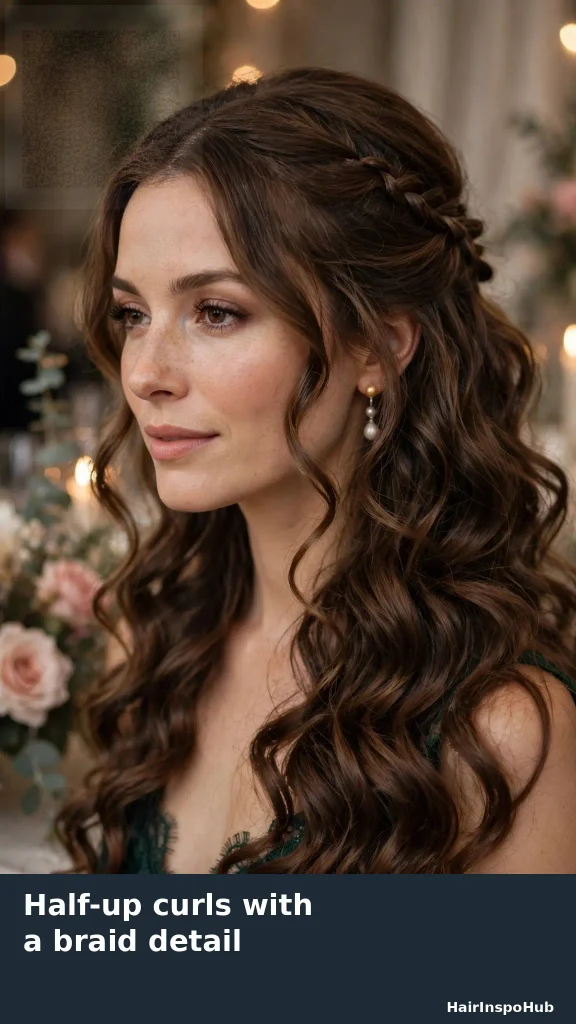
Best for: Prom, weddings and any event with photographs.
Time and skill: 25-35 minutes, intermediate
Curl all the hair loosely first. Braid a slim three-strand or fishtail braid from each temple, pin them together at the back under a small twist of hair, and let the curls fall below. The braid detail is what separates this from a plain half-up: it gives the back of the head something to look at when you turn around, which is exactly when wedding and prom photos are taken. Keep the braids loose; tight temple braids against soft curls look mismatched.
Hold tip: Make the braids before pinning anything. Braiding over already-curled, sprayed hair tangles at the temples.
10. High sleek ponytail with a hair wrap
Best for: Work-to-evening, hot days, strong simple outfits.
Time and skill: 10-12 minutes, beginner
Brush the hair up to a point above the occipital bone, smooth with a bristle brush, and secure with a strong elastic. Take a slim strand from underneath, wrap it around the elastic, and pin it underneath. On long hair the ponytail itself is the accessory: it should swing as one piece, which needs the ends trimmed and a light serum pass. If the base bumps, the brush angle was wrong, not the elastic: brush in the direction of the ponytail from every side before tying.
Hold tip: Anchor trick for heavy hair: make a small ponytail with half the hair first, then add the rest to it with a second elastic. No single elastic holds very long, thick hair high all day.
11. Bubble ponytail
Best for: Fun everyday wear, making fine long hair look thicker, school and casual days.
Time and skill: 6-8 minutes, beginner
Make a regular ponytail, then add small elastics every 7-10 centimetres down its length, gently pulling each section outward into a bubble as you go. Long hair finally wins here: you get four to six bubbles where medium hair gets two. The style needs no heat and hides uneven thickness because every bubble is shaped by hand. Keep the pulls gentle and uneven rather than perfectly round; deliberately irregular bubbles look modern, uniform balls look costumey.
Hold tip: Add the next elastic before shaping the bubble above it. Shaping first and tying after crushes your own work.
12. Low ponytail with a scarf or ribbon
Best for: Polished casual days, greasy-root emergencies, minimal outfits.
Time and skill: 5 minutes, beginner
Brush the hair into a low ponytail at the nape, secure, then tie a scarf or ribbon over the elastic, letting the tails mix with the hair. The accessory sits exactly where the eye lands on a plain low ponytail and upgrades it instantly. This is also the most forgiving style on this list for hair that needs a wash: roots are smoothed back, ends are what people see, and dry shampoo at the part line finishes the disguise.
Hold tip: Choose the accessory after the outfit, not before. A ribbon fighting your neckline loses to both.
13. Messy bun with face-framing tendrils
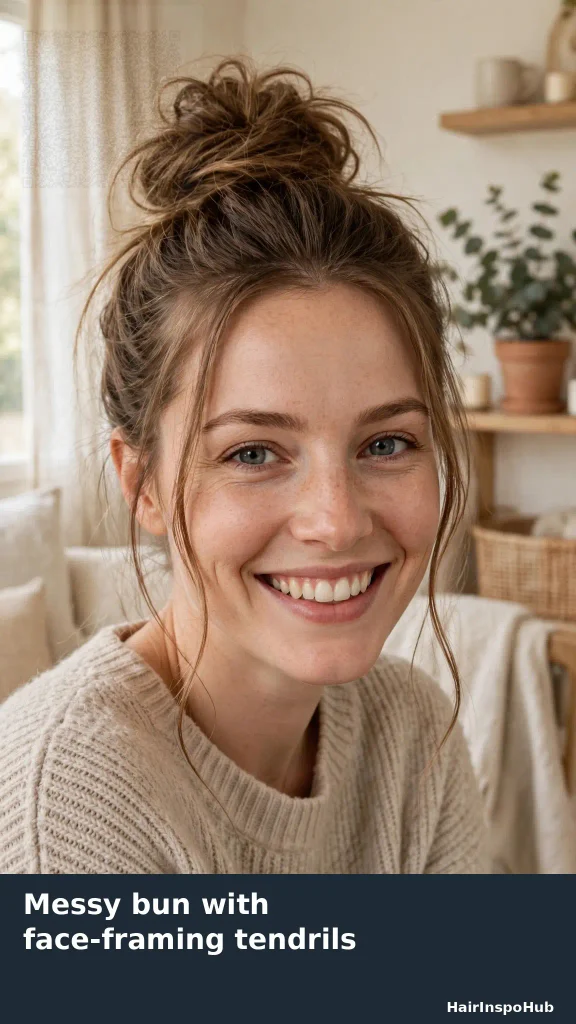
Best for: The everyday default, second-day hair, study and home days.
Time and skill: 5 minutes, beginner
Gather the hair as if for a high ponytail, twist it around its base, and pin or elastic it loosely, then pull out two tendrils at the front and a few pieces at the nape. The tendrils are not decoration; they are what stop a bun on long hair reading as severe. Because the whole length is up, this is also a genuine heatwave style. If your bun slides, your hair is too clean: texture spray, or make it tomorrow’s style instead.
Hold tip: Two elastics beat five pins for beginners: one to make the ponytail, one to secure the twisted bun over it.
14. Low chignon and sleek low bun
Best for: Weddings, interviews, formal evenings, detailed dress necklines.
Time and skill: 12-15 minutes, intermediate
Make a low ponytail, twist the length, coil it flat against the nape, and pin with U-pins pushed in against the twist direction. Leave it sleek for formal wear or pull small pieces loose for a soft version. Long hair makes a chignon look expensive because the coil has real volume; there is no padding or fake bun underneath. Check the profile in a side mirror: the bun should sit at the nape, not stick out behind the neck, which is the giveaway of a rushed version.
Hold tip: U-pins hold by length, bobby pins by grip. A chignon pinned only with bobbies slowly unrolls under its own weight.
15. French twist
Best for: Classic formal occasions, elegant dresses, timeless photographs.
Time and skill: 15-20 minutes, intermediate
Brush all the hair to one side, pin a vertical line of crossed bobby pins up the back, then sweep the hair back over the pins, twist the length upward into a roll, and tuck the ends inside. It is the most architectural style here and the one that most benefits from long hair, because the roll needs length to form. Practice once before the event; the motion is simple but backwards in a mirror. A few pearl or crystal pins along the seam turn it into an occasion style without changing the technique.
Hold tip: The crossed pin line is the foundation. Skipping it is why home French twists collapse; salons never skip it.
16. Top knot and ballerina bun
Best for: Gym sessions, heatwaves, and tall clean looks with strong outfits.
Time and skill: 6-8 minutes, beginner
Make the highest ponytail you can, twist the length tightly, wrap it around the base, and secure with a second elastic plus two pins. A top knot uses the full length as its own height, which is the one trick short hair cannot copy. For workouts, braid the ponytail before wrapping it and nothing will escape mid-session. Keep this style occasional rather than daily in the exact same spot; always tying at one tension point stresses the same hairs at the hairline.
Hold tip: Height placement: sit the knot on the crown, not the back of the head, or it reads as a regular bun from the front.
17. Classic French braid
Best for: All-day hold, active days, and the foundation skill for half the braids in this guide.
Time and skill: 10-12 minutes, intermediate
Start with three small sections at the crown, cross them once, then add a little hair to the outer sections at every cross, keeping the braid snug against the head. The skill is rhythm, not speed. A French braid is the most practical long-hair style that exists: it contains the full length, survives wind and workouts, needs no products, and the braid itself becomes tomorrow’s heatless waves. If your arms tire, rest them on your head briefly rather than loosening the braid; tension lost mid-braid cannot be recovered below it.
Hold tip: Add smaller pieces than you think. Big additions make a lumpy braid and run you out of hair at the sides too early.
18. Dutch double braids
Best for: Sport, festivals, protective days and maximum security.
Time and skill: 15-20 minutes, intermediate
Part the hair down the centre, then Dutch-braid each side: the same adding rhythm as a French braid, but crossing the outer sections under the middle so the braid sits raised on top of the hair. Two braids share the weight that makes one braid pull on long hair, and the style holds for a full active day. Keep the tension firm but never tight at the temples and edges; secure hold and scalp pain are not the same thing, and the style works without the pain.
Hold tip: Braid one full side before starting the other. Alternating sides mid-braid tangles the waiting half in its own length.
19. Side fishtail braid, pancaked
Best for: Romantic looks, photos, dresses with one bare shoulder.
Time and skill: 12-15 minutes, intermediate
Bring all the hair over one shoulder, split it in two, and repeatedly cross a thin strand from the outside of one half to the inside of the other. When tied, gently pull (pancake) each ridge outward to double the braid’s width. Pancaking is why this braid suits long hair so well: the wider the braid, the more length it takes to build, so long hair literally makes a better version. Wear it slightly messy; a fishtail combed to perfection shows every uneven strand.
Hold tip: Thin strands, slow rhythm. Thick strands make a herringbone that looks like a regular braid and takes the same time.
20. Pull-through braid (the beginner’s braid)
Best for: A full braid look with no braiding skill, beginners and tweens.
Time and skill: 10 minutes, beginner
Make a ponytail, split the hair above the elastic to make a hole, and pull the ponytail up through it (a topsy twist). Repeat down the length: add a new elastic, split, pull the hair above through. Each loop stacks into what reads as a thick woven braid from two metres away. It is the kindest entry to braid styles because every step can be undone in seconds, and on long hair the loops have enough length to look genuinely full rather than like a chain of knots.
Hold tip: Elastic spacing decides the look: closer elastics make a tighter woven effect, wider spacing makes big soft loops.
21. Crown braid updo (milkmaid braids)
Best for: Formal events, thick hair, keeping every strand off the neck in summer formality.
Time and skill: 20-25 minutes, advanced
Braid two Dutch or French braids, cross them over the top of the head like a headband, and pin each tail along the opposite braid, tucking the ends underneath. The style distributes very heavy long hair around the whole head instead of loading it onto one bun point, which is why it stays comfortable for a full event. It photographs like a hairstyle that took a salon hour. Stop if the braids pull at the edges: loosen each braid with your fingers before pinning rather than re-braiding tighter.
Hold tip: Pin the tails while the braids are lying where you want them, not after. Moving a pinned crown braid breaks its line.
22. Defined natural curls with a deep side part
Best for: Curly and coily long hair on wash day, celebrations, natural texture on show.
Time and skill: Wash-day routine, intermediate
On wet, conditioned hair, apply leave-in and curl cream in sections, detangle gently with a wide-tooth comb or fingers from the ends upward, then scrunch and dry without touching, with a diffuser or by air. Part deeply to one side once dry for lift at the root. Long curly hair styled this way keeps its pattern from root to end instead of being stretched straight by its own weight at the top and curly only at the bottom. Refresh on later days with a water and leave-in mist, re-scrunching only the flattened sections.
Hold tip: Never brush dry curls before styling. Dry brushing separates the pattern into frizz that no product fully reverses that day.
23. Long twists (protective style)
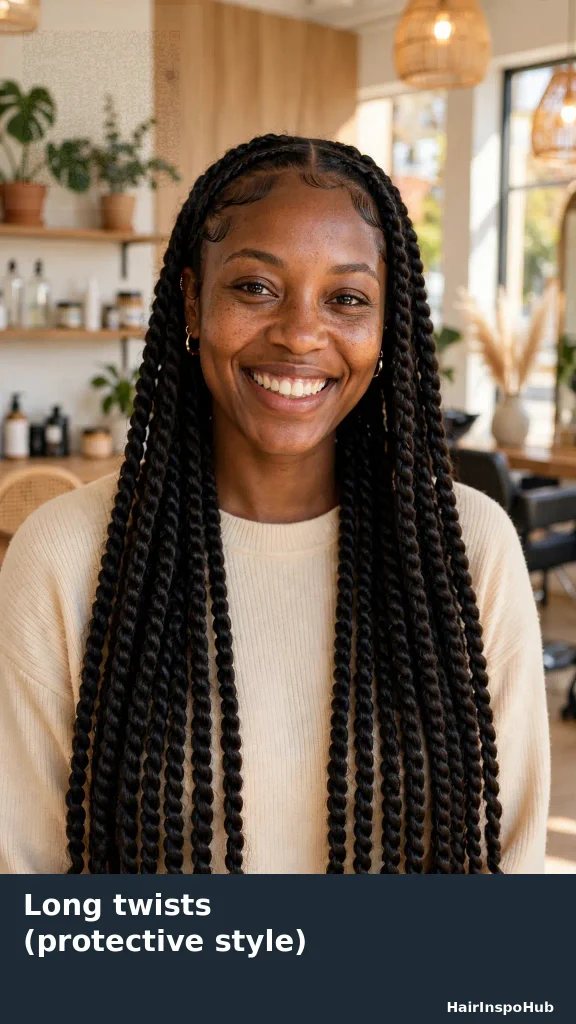
Best for: Multi-day protective wear, holidays, giving manipulated hair a rest.
Time and skill: One long session (or salon visit), then days of wear
Hair is sectioned and twisted in two-strand twists, with or without added hair for length, and worn from several days to a few weeks depending on size and care. As a protective style, the value is what does not happen: no daily heat, no daily brushing, and ends tucked inside the twists rather than rubbing on shoulders and collars. Keep the scalp clean and moisturised during wear, keep edge twists loose, and take them down gently without pulling. This is a hairstyle in its own right, chosen for low daily effort, not a commitment to hide your hair.
Hold tip: Tightness on day one decides comfort for the whole wear. Twists that hurt at the scalp are too tight, full stop.
24. Loose waves with a pearl, bow or clip accessory
Best for: Party upgrades, dinners, turning day hair into evening hair in minutes.
Time and skill: 15-20 minutes, beginner
Make loose waves (heat or braid waves both work), then place the accessory with intention: pearl pins scattered on one side, a bow at a half-up join, or a single statement clip above one ear. The rule is one accessory moment, placed where the part or the pin already draws the eye. On long hair this works because the waves give the accessory a background; on a plain style the same clip looks like an afterthought. This is the fastest legitimate way to make yesterday’s hairstyle look like a new one.
Hold tip: Remove the accessory before sleeping. Pins slept on bend, break hair, and occasionally find the pillow’s revenge by morning.
25. Braided high ponytail
Best for: Gym-to-out days, secure styles with swing, keeping hair off the face and neck.
Time and skill: 10-12 minutes, intermediate
Make a high ponytail, then braid its full length and tie the end. The braid stops the ponytail tangling into a single mat during activity, which is the hidden problem of long ponytails, and the finished style still swings and reads clearly as long hair. For a softer version, braid only the top third and leave the ends loose. This is also the most secure style here for fine, slippery hair, because the braid holds what a plain ponytail’s own weight would slowly pull loose.
Hold tip: Brush the ponytail before braiding, never after. Brushing a finished braid to smooth it undoes the braid.
Choose by hair type (the same style is not the same style)
| Hair type | Best styles from this guide | What to change |
| Fine or thin long hair | Bubble ponytail (11), blowout layers (4), claw-clip half-up (6) | Dry texture spray before styling; choose styles that shape the hair, not weigh it down; skip heavy oils except a drop on ends |
| Thick or heavy long hair | French braid (17), low chignon (14), crown braid (21) | Anchor every updo with an elastic first; use two elastics for ponytails; section with clips so arms and pins are not fighting the full weight at once |
| Wavy hair | Braid waves (3), twisted crown (7), side fishtail (19) | Style on the wave’s terms: add hold products on damp hair and hands off while drying; braids tame uneven waves into one pattern |
| Curly hair (defined curls) | Defined curls down (22), half-up twisted crown (7), pineapple at night | Detangle wet and conditioned only; diffuse or air-dry untouched; refresh with mist rather than rewetting everything |
| Coily hair | Long twists (23), Dutch double braids (18), crown braid (21) | Prioritise low tension and moisturised ends; styles should last days, not demand daily restyling; edges stay loose in every version |
| Straight, slippery hair | Pull-through braid (20), sleek ponytail (10), glass-straight (2) | Grip is your product category: texture spray, matte elastics, and pins crossed in pairs; wash-day hair holds updos worst, day-two hair best |
| Damaged or bleached lengths | Braid waves (3), messy bun (13), low ponytail (12) | Heat styles move to special occasions only, always with protectant; the ends are the oldest hair on your head and break first |
How to make a long hairstyle last all day (and into day two)
| Problem | Cause on long hair | Fix that actually works |
| Updo slides down by lunch | Weight on pins alone, slippery clean hair | Elastic anchor first, pins second; style on day-two hair or add texture spray |
| Waves drop flat | Curls brushed while warm; sections too thick for the length | Full cooling time; larger barrel, thinner sections; braid waves for a heat-free set that cannot drop the same way |
| Ponytail gives you a headache | All the weight hung from one tight point | Split-anchor ponytail (two elastics); move the position slightly each day; loosen, it should hold without pain |
| Braids frizz at the front | Short front layers escaping; dry hair braided roughly | Braid on slightly damp or product-smoothed hair; leave tendrils out deliberately so escape looks intentional |
| Ends look thin and stringy by evening | Over-brushing during the day; dry oldest hair | Serum on ends only; hands instead of a brush for restyling; trim schedule below |
| Style creases after sleeping | Loose hair folding under you all night | Pineapple (loose high scrunchie) for curls; single loose braid or silk scrunchie bun for straight/wavy hair |
The night routine is the cheapest styling step in this guide: long hair styled in ten minutes at night (braids for waves, a pineapple for curls, a loose scrunchie bun for straight hair) wakes up styled. Most ‘morning’ hairstyles people admire are actually evening hairstyles with good timing.
5 mistakes that quietly ruin long hairstyles
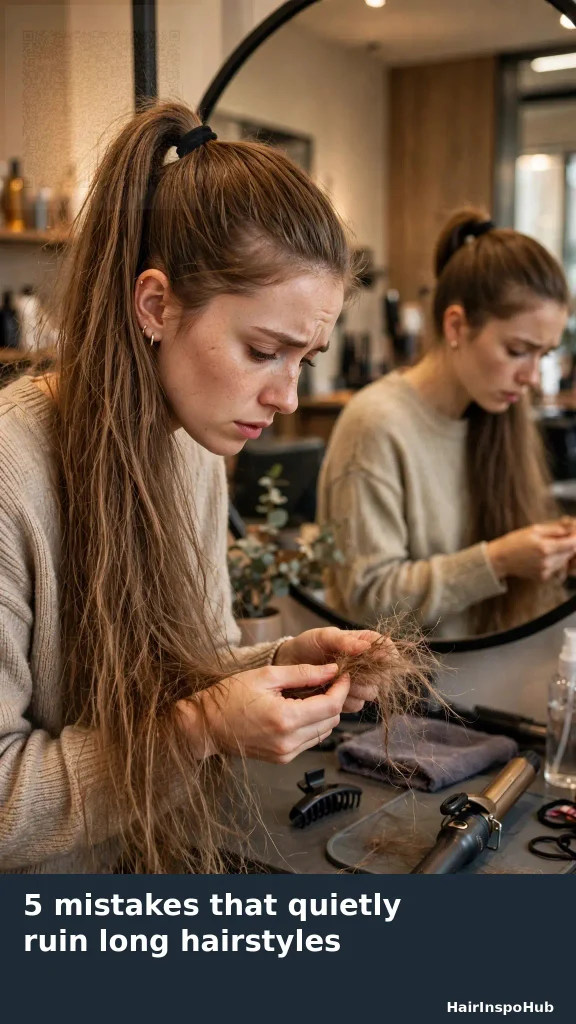
Mistake 1: Tying at the same tight spot every day
A daily ponytail at one exact point and tension stresses the same hairs until they snap, and constant tight pulling can cause traction hair loss at the hairline. Rotate the height, use scrunchies for home days, and treat pain as information: a hairstyle that hurts is too tight, not extra secure.
Mistake 2: Heat without protectant on years-old ends
The last 15 centimetres of long hair may be three or more years old and have survived hundreds of washes. Direct iron heat on that hair with no protectant is the fastest route to split, frayed ends that make every style look tired. Protectant before every heat style, and keep full heat for occasions.
Mistake 3: Metal-joint elastics and brushing out tangles dry
Cheap elastics with metal joints cut strands at the tie point, which is why ‘mystery breakage’ often appears exactly where a ponytail sits. And detangling long hair means starting at the ends and working up, with conditioner in the shower for curly hair, never ripping a brush from root to end through dry tangles.
Mistake 4: Skipping trims to ‘keep the length’
Split ends travel upward. Hair trimmed a centimetre every 8 to 12 weeks keeps more total length over a year than hair left alone until 10 damaged centimetres must come off. Trims are also why styled long hair looks thick at the hem in photos; frayed ends photograph thin in every style.
Mistake 5: Copying a style built for a different hair type
A glass-straight look forced onto high-shrinkage curls with daily heat, or a wash-and-go expected from hair with no natural pattern, sets you up to fight your hair every morning. The hair-type table above exists so the style and the hair agree before you start. The most sustainable hairstyle is the one your hair nearly does by itself.
Long hair care basics that make every style look better
Hairstyles sit on top of hair condition; no technique fully hides dry lengths. The habits that matter most for long hair are unglamorous and proven: wash mainly the scalp and let the rinse clean the lengths, condition every wash and detangle then, use a deep-conditioning treatment weekly if you heat-style or colour, and keep ends trimmed on the 8-to-12-week rhythm. The American Academy of Dermatology’s general advice to handle hair gently, limit heat, and protect it from friction applies double at long lengths, simply because each strand has been exposed for longer. Sleep friction is real friction: a satin pillowcase or a loose night style reduces the tangles you would otherwise brush out, and break, in the morning.
Frequently asked questions
What is the easiest hairstyle for long hair?
The claw-clip half-up, the messy bun and the bubble ponytail are the easiest long hairstyles: each takes five minutes or less, needs one clip or a few small elastics, and works on second-day hair without heat. For a braid look with no braid skill, the pull-through braid is the beginner’s option.
What hairstyle suits long hair for a wedding or prom?
Half-up curls with a braid detail, a low chignon, Hollywood waves and a French twist are the most reliable long-hair event styles. Choose by dress: bare shoulders suit hair down in waves, a detailed neckline or back suits an updo that shows it off.
How can I style long hair without heat?
Braid waves set overnight, twisted half-ups, pull-through braids, buns and scarves all style long hair with no heat at all. Heatless waves from braids also outlast heat curls on many hair types because the set comes from the braid’s shape, not from a tool.
Which hairstyles make long hair look thicker?
The bubble ponytail, blowout layers, pancaked fishtail braid and any style with root lift make long hair read thicker. Regular small trims matter as much as the style: a clean hem always looks fuller than frayed ends.
How do I stop a ponytail hurting on long hair?
Use the split-anchor method (a small ponytail first, then add the rest), sit the ponytail slightly differently each day, and loosen it until it holds without pain. Pain means the load is on too few hairs; spreading the anchor, not enduring it, is the fix.
What is the best gym hairstyle for long hair?
Dutch double braids, a braided high ponytail and a top knot anchored with an elastic first all survive a full workout. Braiding the ponytail stops long hair matting into one tangle during movement.
How often should long hair be trimmed if I am growing it?
A small trim, around a centimetre, every 8 to 12 weeks. Removing split ends before they travel up the strand preserves more length over a year than skipping trims and eventually cutting off a long damaged section.
Are tight hairstyles bad for long hair?
Worn occasionally, a sleek tight style is fine. Worn tightly every day, especially at the same point, tight styles can break hair and cause traction hair loss at the hairline. Rotate styles, keep edges loose, and never sleep in a tight style.

Stella Mary is a US-based hair care enthusiast and lifestyle writer at HairInspoHub, sharing trend-forward hairstyle tutorials, styling tips, and healthy hair rituals for women of every hair type. Specializing in Pinterest-inspired looks from bridal updos and effortless braids to heatless waves and sleek ponytails. She blends timeless elegance with everyday practicality. Her mission making gorgeous, confidence-boosting hairstyles accessible to everyone, one tutorial at a time.