
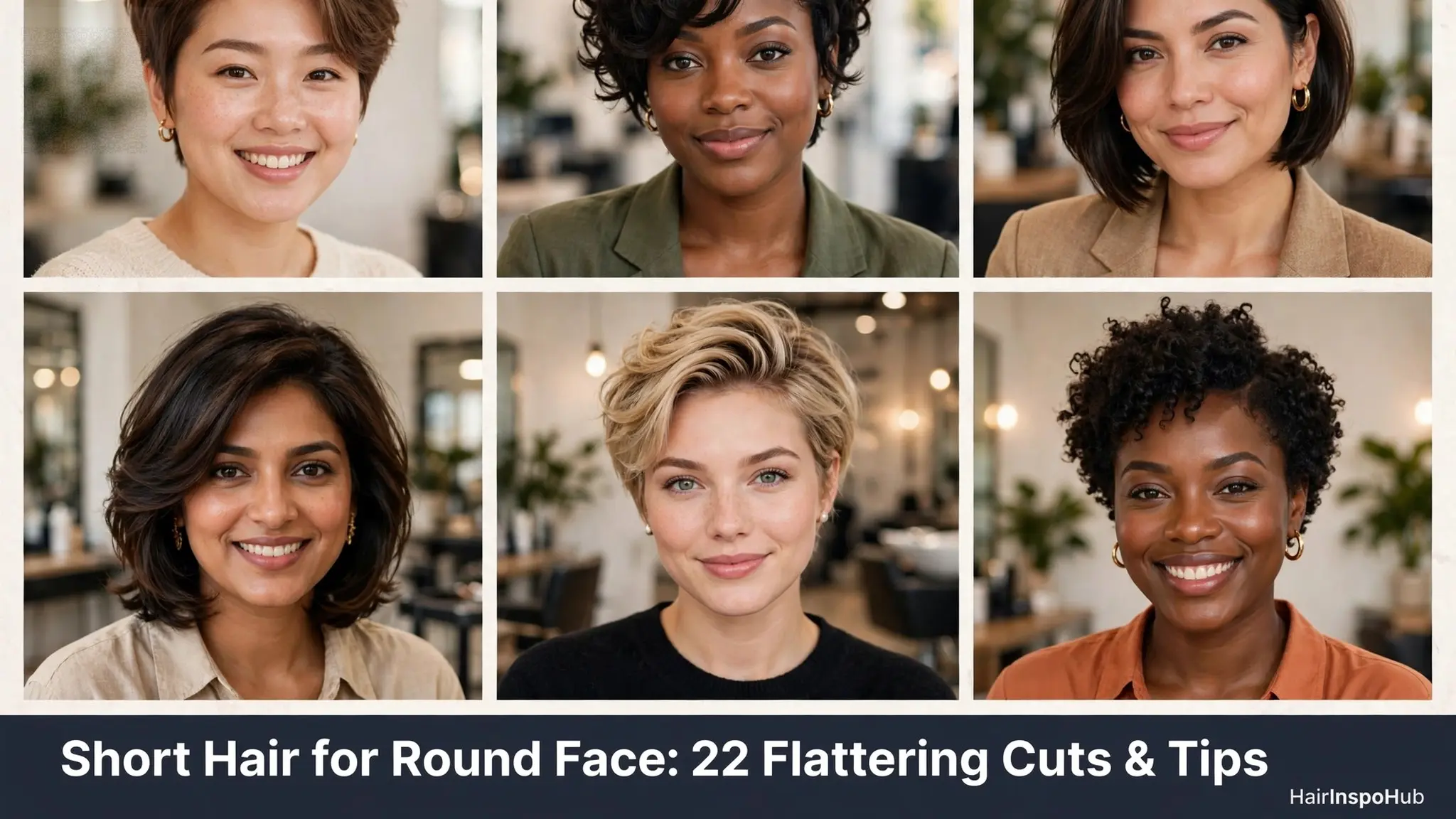
Short Hair for Round Face: 22 Flattering Cuts That Add Length, Not Width

Short hair does not make a round face look bigger. The wrong short hair does. A cut that is flat on top, wide at the cheeks and blunt at the chin will copy the shape of the face. A cut that lifts at the crown, cuts a diagonal line across the forehead and keeps the sides close will do the opposite: it adds visible length and makes the face look more oval.
This guide is built as a decision guide, not just a photo list. You will first check whether your face is truly round, learn the three rules every flattering short cut follows, then choose from 22 cuts matched to your hair type, your upkeep level and your main concern, whether that is fuller cheeks, a double chin, fine hair, thick curls, glasses or hair over 50. Every idea tells you why it works, who it suits best, the exact words to use at the salon and how often it needs a trim.
Save the photos you like, but take the salon script with you too. For round faces, the difference between a flattering cut and a widening cut is usually one sentence to your stylist about where the length, layers and volume should sit.
Quick answer: what is the best short hair for a round face?
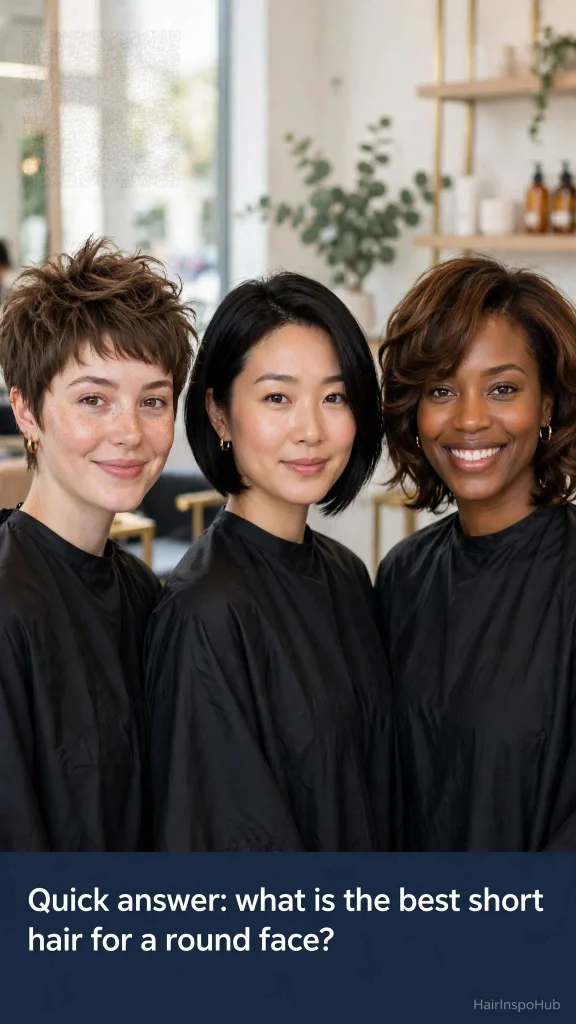
The best short hair for a round face adds height at the crown, keeps volume off the cheeks and creates at least one diagonal line, usually a deep side part, a side-swept fringe or a longer front piece. The most reliable cuts are a textured pixie with crown lift, a long pixie with a side fringe, an angled bob that ends below the chin, a layered lob, a bixie with a deep side part and a short shag with a curtain fringe.
- Safest first short cut: a layered lob or angled bob ending 2 to 5 cm (about 1 to 2 inches) below the chin, with a side part.
- Boldest flattering cut: an asymmetrical pixie or undercut pixie with a long top and close sides.
- Lowest upkeep: a tapered pixie or bixie styled with fingers and a pea-sized amount of paste.
- Best for fine hair: a feathered pixie-bob with light layers that create lift without thinning the ends.
- Best for thick or curly hair: a short shag or curly crop with height on top and weight removed from the sides.
- Avoid as a first try: a blunt, one-length bob ending exactly at the chin or cheek, a flat top with wide sides, and a heavy straight fringe cut low across the forehead.
Short hair for a round face at a glance
| Your priority | Best cuts from this guide | Key rule to remember |
| Look longer and slimmer | Textured pixie (1), angled bob (5), layered lob (6) | Height on top, length below the chin |
| Keep some length | Layered lob (6), Italian bob (7), wavy bob (11) | Front pieces must pass the chin |
| Go very short safely | Asymmetrical pixie (3), undercut pixie (12), tapered crop (17) | Close sides, longer diagonal top |
| Fine or thin hair | Feathered pixie-bob (16), bixie (4), choppy bob (14) | Light layers, never over-thinned ends |
| Thick, wavy or curly hair | Short shag (9), curly crop (10), wolf cut (15) | Remove side weight, push volume up |
| Fuller face or double chin | Long-front bob (21), angled bob (5), long pixie (2) | No line ending at the jaw; front falls past it |
| Over 50 or grey hair | Silver feathered pixie-bob (20), Italian bob (7) | Soft edges, lift at crown, no hard blunt line |
| Wear glasses daily | Ear-length pixie-bob (22), long pixie (2) | Keep the ear and temple area clean for frames |
How to tell if you really have a round face
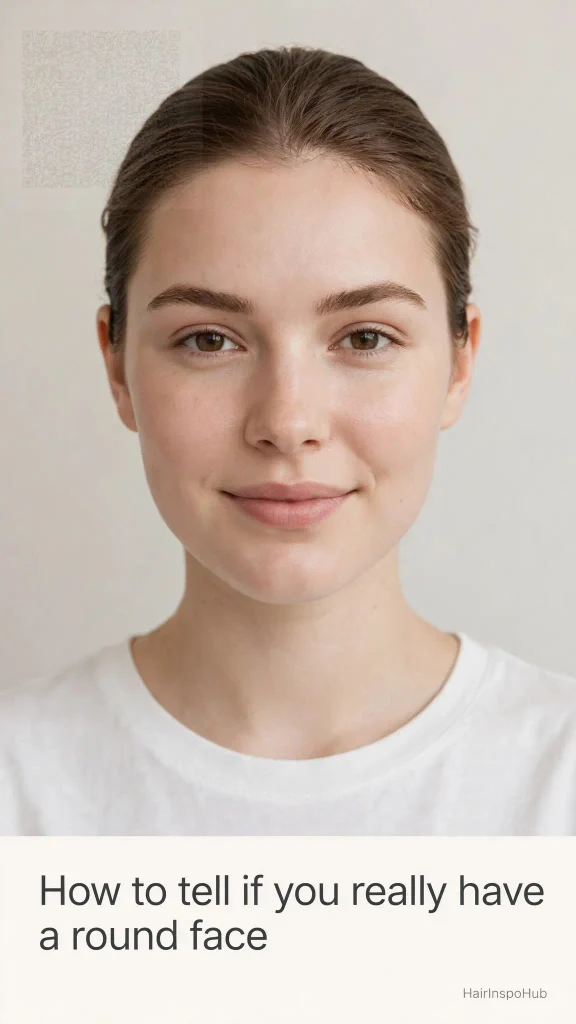
Many readers land on this page after being told their face is round, when it is actually oval, square with soft corners, or heart-shaped. The cut advice changes with the shape, so check first. Pull your hair fully back, stand in even light and look straight at a mirror or a front phone photo.
- Forehead, cheekbones and jaw are all at a similar width, with no strong angles at the jaw.
- The face length and face width look close to equal.
- The chin is rounded or soft rather than pointed or square.
- The widest point is usually the cheeks.
A quick measure helps: if your face length (hairline to chin) is only slightly longer than your face width (cheek to cheek), and your jaw curve is soft, treat your face as round for this guide. If your jaw is clearly wider and angular, look at softening cuts for square faces instead. If your forehead is clearly wider than a narrow chin, heart-face advice about adding jaw fullness will suit you better. When in doubt, ask your stylist to confirm your shape before the first short cut; it takes ten seconds with hair pulled back.
The 3 rules every flattering short cut for a round face follows
Rule 1: Put the height on top, not at the sides
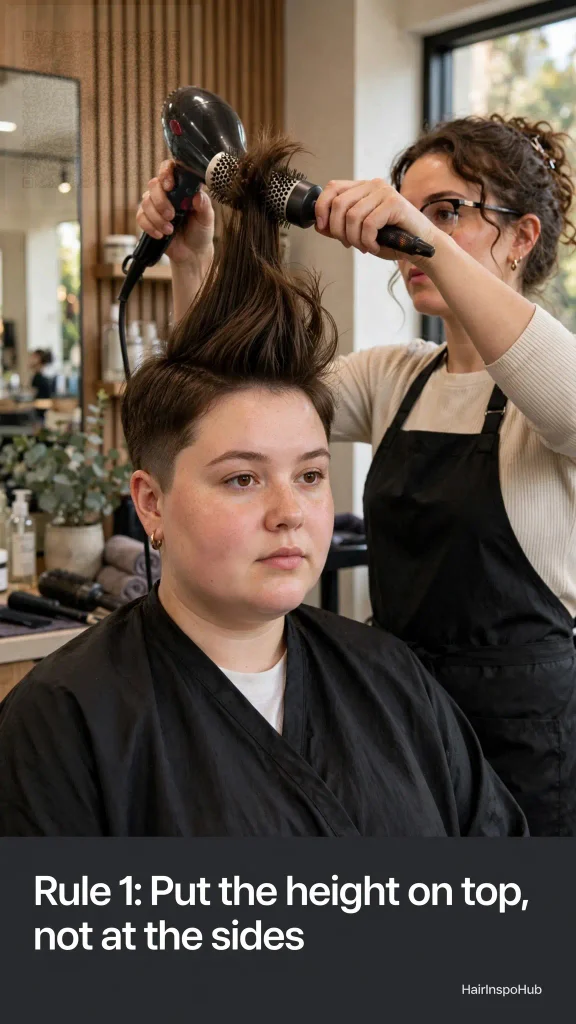
Length is an illusion created by direction. Volume lifted at the crown pulls the eye upward, so the face reads longer. Volume pushed out at the cheeks does the reverse. That is why a pixie styled up and a bob blow-dried with root lift flatter a round face, while the same cuts dried flat and wide do not. Whatever cut you choose, your daily styling question is simple: is the volume going up or out? Up is your friend.
Rule 2: Break the circle with a diagonal line
A round face has no straight lines, so add one. A deep side part, a side-swept fringe, an asymmetrical length difference or longer front pieces all cut a diagonal across the circle and make it look narrower. A centre part on a blunt bob does the opposite: it frames both cheeks equally and underlines the width. You do not need all the diagonals at once. One clear diagonal is enough.
Rule 3: Never end the cut at the widest point
Where a cut ends is where the eye stops. A bob ending exactly at the cheek or chin draws a horizontal line across the widest part of the face. End above it with a pixie that clears the cheek, or below it with front pieces that fall past the chin. This single placement choice explains most short-hair regrets on round faces, and it is the easiest one to fix at the salon: move the line.
Quick-pick table: all 22 short hairstyles for round faces
Use this table to shortlist two or three ideas, then read only those sections in full. Upkeep means salon trims, not daily styling time.
| # | Cut | Best for | Upkeep |
| 1 | Textured pixie with crown height | Fine to medium hair, first pixie | Trim 4-6 weeks |
| 2 | Long pixie with side fringe | Want short but not too short | Trim 5-7 weeks |
| 3 | Asymmetrical pixie | Bold change, strong diagonal | Trim 4-6 weeks |
| 4 | Bixie with deep side part | Fine hair, soft grow-out | Trim 6-8 weeks |
| 5 | Angled A-line bob below chin | Most hair types, safe classic | Trim 6-8 weeks |
| 6 | Layered lob past the chin | Nervous about going short | Trim 8-10 weeks |
| 7 | Italian bob with root lift | Medium to thick hair, polished look | Trim 6-8 weeks |
| 8 | French bob, round-face version | Straight to wavy hair, chic look | Trim 5-7 weeks |
| 9 | Short shag with curtain fringe | Thick or wavy hair, relaxed style | Trim 7-9 weeks |
| 10 | Curly pixie and curly crop | Natural curls and coils | Shape 6-8 weeks |
| 11 | Wavy textured bob, deep side part | Natural wave, everyday wear | Trim 6-8 weeks |
| 12 | Undercut pixie | Thick hair, edgy and cool in heat | Sides 3-5 weeks |
| 13 | Sleek side-part bob, one side tucked | Straight hair, neat office look | Trim 6-7 weeks |
| 14 | Choppy bob with piece-y ends | Fine to medium hair, movement | Trim 6-8 weeks |
| 15 | Mini wolf cut and short mullet shag | Trend-led, thick or wavy hair | Trim 6-8 weeks |
| 16 | Feathered layered bob | Fine, thin or mature hair | Trim 6-7 weeks |
| 17 | Tapered crop and soft buzz pixie | Lowest daily effort, bold look | Trim 3-5 weeks |
| 18 | Short tapered natural crop | Coily hair, defined shape | Shape 4-6 weeks |
| 19 | Bob with face-frame highlights | Any bob, colour instead of length change | Colour 8-12 weeks |
| 20 | Silver feathered pixie-bob over 50 | Mature hair, grey or thinning | Trim 5-7 weeks |
| 21 | Long-front cut for fuller face | Double chin or full lower face concern | Trim 6-8 weeks |
| 22 | Ear-length pixie-bob for glasses | Daily glasses wearers | Trim 5-7 weeks |
22 short hairstyles for round faces, matched to your hair and your life
Each idea below follows the same order: why it works on a round face, who it suits best, what to ask your stylist and the upkeep to expect. That way you can compare cuts fairly instead of choosing from a photo alone, because the same photo cut two different ways can flatter or widen your face.
1. Textured pixie with crown height
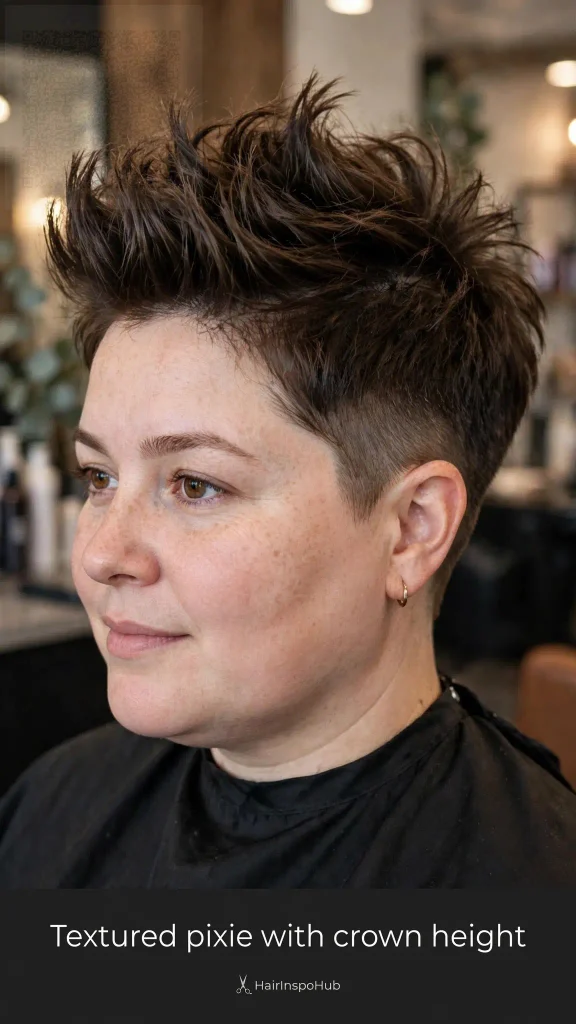
Why it works: This is the reference pixie for round faces: short, tapered sides, a longer textured top that is styled up and slightly forward, and no bulk sitting over the ears. The crown height does the lengthening work, the texture stops the top from looking like a flat cap, and the clean sides stop the silhouette copying the width of the cheeks.
Best for: Fine to medium hair that needs lift, and anyone trying a pixie for the first time. It photographs well from the front, which is why it is a favourite for profile photos.
Ask your stylist: “Taper the sides close, keep 5 to 8 cm (2 to 3 inches) of textured length on top, and leave the fringe piece-y so I can sweep it diagonally. No volume over the ears, please.”
Upkeep: Trim every 4 to 6 weeks. Daily styling is 3 to 5 minutes: root spray on damp hair, blow-dry the top up with fingers, finish with a pea-sized amount of matte paste.
2. Long pixie with a side-swept fringe
Why it works: The long pixie (sometimes called a lixie) keeps more length at the front and nape, so it feels less exposed than a classic pixie while keeping the same slimming structure. The side-swept fringe draws a long diagonal from the part to the opposite cheek, which is exactly the line a round face needs, and the extra front length softens the jaw.
Best for: Anyone who wants short hair but is nervous about going very short, and readers who wear their hair behind one ear. It also grows out gracefully into a bixie.
Ask your stylist: “Keep the front long enough to sweep across my forehead and tuck behind one ear. Taper the back and sides, and keep the part deep on one side.”
Upkeep: Trim every 5 to 7 weeks. It tolerates a missed appointment better than shorter pixies because the shape is meant to look slightly grown in.
3. Asymmetrical pixie
Why it works: One side is cropped close while the other falls into a longer sweeping section. That obvious length contrast puts a shadow and a diagonal across one cheek, so the eye reads movement instead of width. It is the strongest diagonal in this guide, which is why it suits readers who feel other cuts still look too symmetrical and sweet.
Best for: Medium to thick hair, straight to wavy textures, and anyone ready for a clear style statement. It needs confidence more than it needs product.
Ask your stylist: “Make the asymmetry obvious, not slight: close on one side, at least 8 to 10 cm (3 to 4 inches) sweeping over on the other. A tiny difference will just look uneven.”
Upkeep: Trim every 4 to 6 weeks to keep the contrast sharp. Style the long side across, not down flat, or the diagonal disappears.
4. Bixie with a deep side part
Why it works: The bixie sits between a bob and a pixie: bob length with pixie layering. With a deep side part it gives round faces the softness of a bob without the blunt horizontal line, because the layers and the part break the outline at two points. It is one of the easiest cuts to grow out in either direction.
Best for: Fine to medium hair, first-time short-hair readers, and anyone who wants one cut that can look neat or tousled. It suits a wide age range.
Ask your stylist: “Cut a bixie that sits between my ear and chin, with light pixie layers through the top and a deep side part. Keep the ends piece-y, not blunt.”
Upkeep: Trim every 6 to 8 weeks. Finger-style with mousse for a soft finish, or add paste at the ends on days you want more edge.
5. Angled A-line bob that ends below the chin
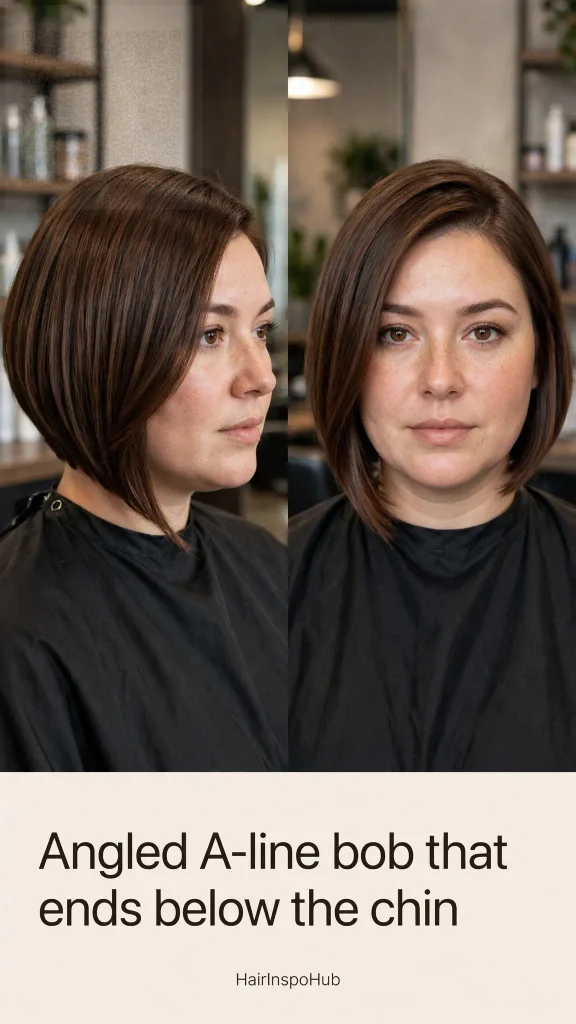
Why it works: The back is shorter and the front is longer, so the hemline slopes down past the chin instead of cutting across it. That downward slope is the whole trick: the eye travels down the angle and reads length. Internal layers stop the front from hanging like two heavy curtains beside the cheeks.
Best for: Almost every hair type except very tight curl (see idea 10 instead). This is the safest salon classic for round faces and the one to choose when you must look polished at work.
Ask your stylist: “Angle the bob so the front ends 2 to 5 cm below my chin and the back sits higher at the nape. Add light internal layers so the front does not sit heavy on my cheeks.”
Upkeep: Trim every 6 to 8 weeks. Blow-dry with a round brush pulling the front down and slightly under; never flip the ends out at cheek height.
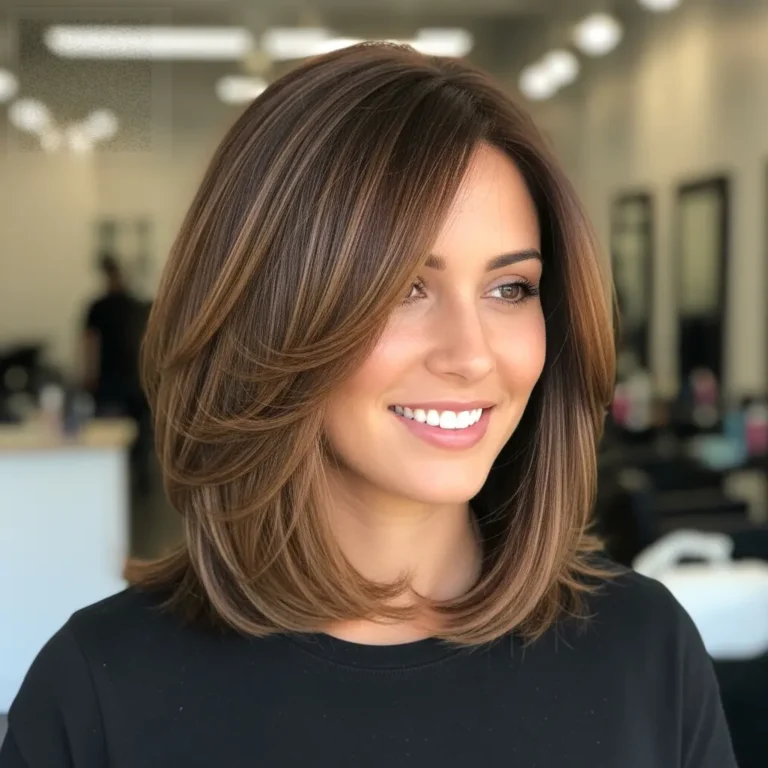
6. Layered lob: the long bob past the chin
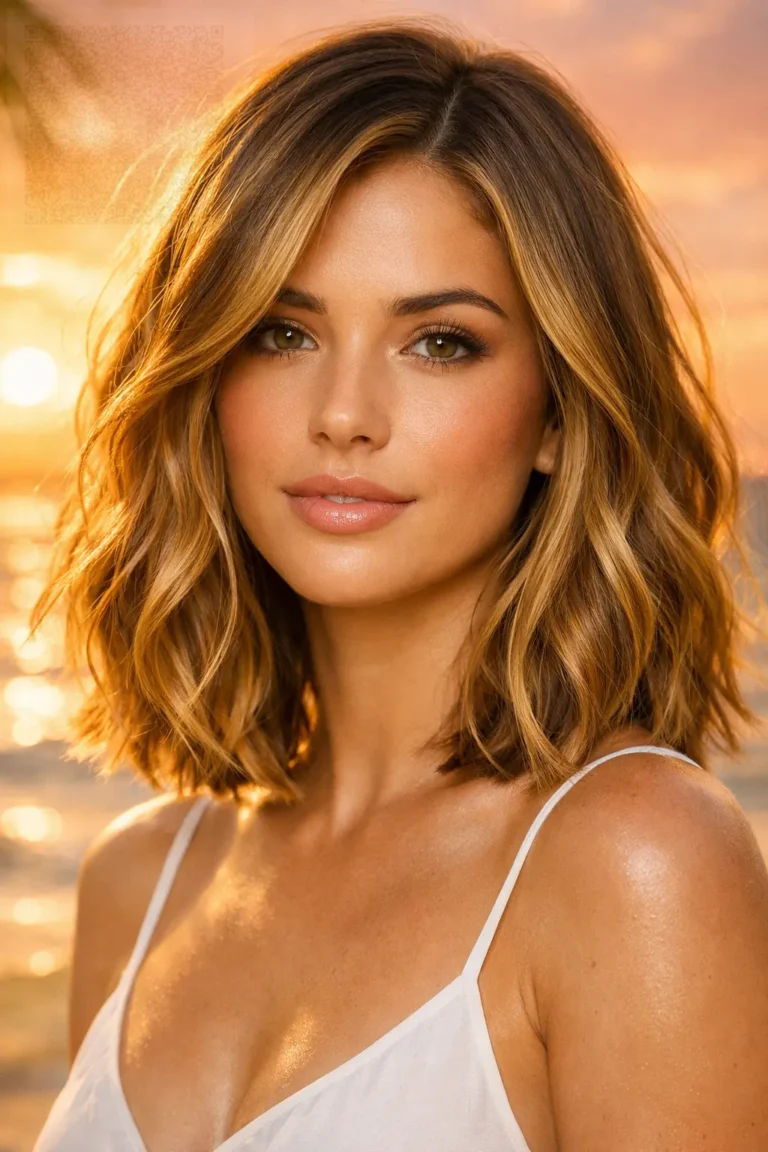
Why it works: A lob that rests between the jaw and the collarbone keeps the comfort of length while the layers remove the box shape of a one-length cut. Because the ends sit well below the widest point, it is the most forgiving option in this guide and the best bridge cut if you may grow your hair again.
Best for: Readers who are nervous about short hair, thicker hair that needs weight removed, and anyone whose work or family setting makes a pixie feel like too big a jump.
Ask your stylist: “Keep the length below my jaw, closer to the collarbone, with soft internal layers and face-framing pieces that start below the cheekbone and fall toward the chin.”
Upkeep: Trim every 8 to 10 weeks, the lowest salon upkeep of the bob family here. A quick refresh is to re-cut only the face-framing pieces between full appointments.
7. Italian bob with root lift
Why it works: The Italian bob is a fuller, bouncier bob with a structured outline and movement through the ends. On a round face it works when the bounce is built at the roots and through the back, not pushed out at the cheeks. Worn with a side or off-centre part, it reads expensive and deliberate rather than round and puffy.
Best for: Medium to thick, straight to wavy hair, and readers who enjoy a proper blow-dry finish. It is a strong choice for events and photos.
Ask your stylist: “Give me an Italian bob with lift at the roots and movement in the ends, but keep the sides smooth against my cheeks, not blown out wide.”
Upkeep: Trim every 6 to 8 weeks. It asks for a 8 to 10 minute blow-dry; on low-effort days, a side part and tucked side keep it tidy.
8. French bob, the round-face version
Why it works: A classic French bob often ends at the jaw with a full fringe, which is a risky combination on a round face. The adjusted version keeps the chic short outline but lengthens the front past the chin, swaps the full fringe for a soft brow-skimming or side fringe, and adds a slight tuck under at the ends so the line curves in instead of sitting straight across the cheeks.
Best for: Straight to lightly wavy hair and readers who love the French look but have been told a bob will widen their face. The adjustment, not the name, makes it work.
Ask your stylist: “I want a French bob shape, but the front must pass my chin and I need a soft side fringe instead of a heavy straight fringe, so it does not widen my face.”
Upkeep: Trim every 5 to 7 weeks because the outline is precise. If the front creeps up to chin level at a trim, ask for the length back.
9. Short shag with a curtain fringe
Why it works: The shag uses layers through the crown and lighter, flicked ends to create movement in several directions, mostly upward. A curtain fringe, split and swept out from the centre, frames the face without drawing a straight line across the forehead. Together they give a round face texture and height with a relaxed, undone finish.
Best for: Medium to thick and wavy hair, and readers who dislike neat, sleek styles. It hides an uneven grow-out better than any bob.
Ask your stylist: “Cut a short shag with layers concentrated at the crown, light ends, and a curtain fringe I can split. Keep the heaviest layers above my cheekbones, not at them.”
Upkeep: Trim every 7 to 9 weeks. Scrunch in mousse or sea-salt spray and air-dry or diffuse; over-brushing a shag flat removes its benefit.
10. Curly pixie and curly crop with height on top
Why it works: Curly hair does not need to be straightened to flatter a round face. It needs shape: fuller and higher on top, closer at the sides and nape, with the curl cut dry or curl-by-curl so the silhouette is visible while it is being built. When curls expand equally in every direction they add width; when they are directed up they add the same crown height as any pixie.
Best for: Natural curls and waves, from loose waves to defined curls. Ask for a stylist who cuts curly hair regularly; the cutting method matters more here than the product.
Ask your stylist: “Shape my curls higher on top and closer at the sides. Please cut it with my curl pattern visible, and do not thin the top, I need that height.”
Upkeep: Reshape every 6 to 8 weeks. Diffuse upward at the roots, keep side curls defined and close with cream, and refresh with water and a little leave-in between washes.
11. Wavy textured bob with a deep side part
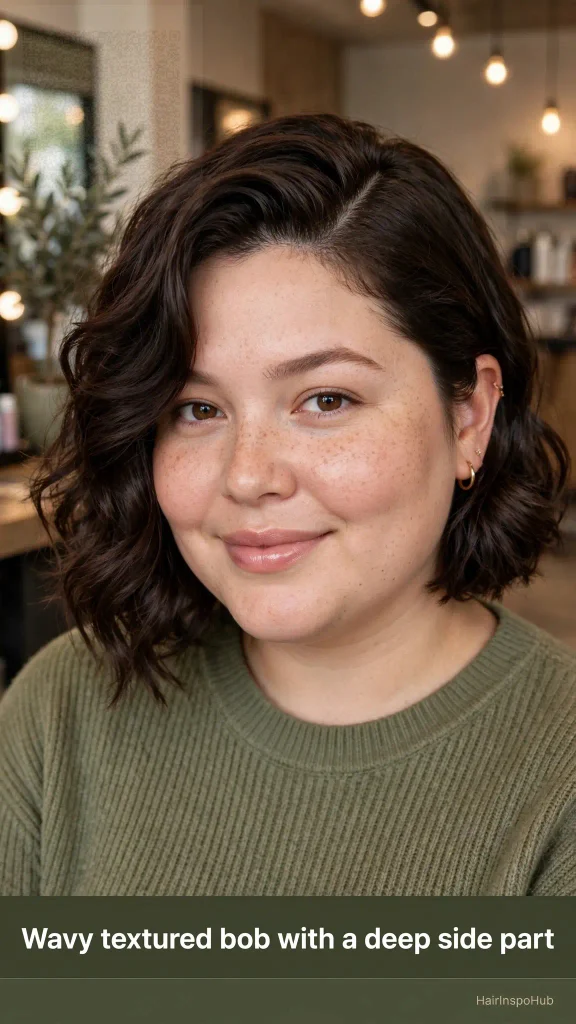
Why it works: Loose waves soften a bob, but the part decides whether they flatter a round face. A deep side part throws most of the wave to one side, creating the diagonal and a little root height at the part itself. The waves should bend, not balloon: large soft bends through the mid-lengths with smoother roots.
Best for: Naturally wavy hair, and straight hair readers happy to add a bend with a flat iron a few times a week. It is an easy everyday cut that still looks styled.
Ask your stylist: “Cut a textured bob ending below my chin, and show me where my deep side part should sit, in line with the arch of my eyebrow.”
Upkeep: Trim every 6 to 8 weeks. Create bends with a flat iron in 4 to 6 sections, leave the ends straighter, and break the waves up with fingers, never a brush.
12. Undercut pixie
Why it works: The sides and back are clipped very short while the top stays long enough to sweep up or across. Removing that side bulk entirely is the fastest way to stop a short cut copying the width of the face, and it feels cool in hot weather. The long top gives you two looks: swept across on neat days, lifted on bold days.
Best for: Thick hair that feels heavy in normal pixies, and readers who like an edgy finish. It is less suited to very fine hair, where the top can look sparse against clipped sides.
Ask your stylist: “Clip the sides and back short, keep the top long enough to sweep diagonally, and blend the join so there is no shelf sitting over my ears.”
Upkeep: The sides need attention every 3 to 5 weeks even if the top can wait. Many readers book a quick sides-only tidy between full cuts.
13. Sleek side-part bob with one side tucked
Why it works: This neat bob is cut like idea 5 but styled deliberately flat and glossy: a deep side part, the shorter side tucked behind the ear to expose the jawline, and the longer side falling forward past the chin. The exposed ear and jaw on one side and the falling curtain on the other give a round face two different angles at once.
Best for: Straight, fine to medium hair and readers who need a tidy, professional finish. It uses the least product of any bob here.
Ask your stylist: “Cut a side-part bob with the front below my chin, smooth ends and no flick. I will tuck one side, so keep that side clean around my ear.”
Upkeep: Trim every 6 to 7 weeks because sleek cuts show uneven ends early. A shine serum is optional; the shape, not the product, does the work.
14. Choppy bob with piece-y ends
Why it works: Instead of one clean hemline, the ends are cut into soft separate pieces. On a round face this shattered line is useful because there is no single horizontal edge for the eye to measure width against. Light choppiness through the mid-lengths also gives fine hair the impression of more movement.
Best for: Fine to medium, straight to wavy hair, and readers who find classic bobs look too severe. It pairs well with subtle highlights (idea 19).
Ask your stylist: “Make the ends piece-y and shattered rather than blunt, with the longest pieces below my chin. Keep the choppiness light so my fine ends do not look thin.”
Upkeep: Trim every 6 to 8 weeks. Style with a small amount of texturizing spray at the ends; heavy wax will clump the pieces together and lose the effect.
15. Mini wolf cut and short mullet shag
Why it works: The short wolf cut keeps a shag’s crown layers and adds slightly longer, tapered length at the back. On a round face the crown layers supply height while the tapered back stops the cut looking like a helmet. It is trend-led, so bring photos; the name alone means different lengths in different salons.
Best for: Thick or wavy hair and younger, fashion-led readers. It is a poor match for very fine straight hair, which cannot hold the separated layers.
Ask your stylist: “I want a short wolf cut: choppy layers and height at the crown, tapered and light at the back and sides, nothing wide sitting at my cheeks.”
Upkeep: Trim every 6 to 8 weeks. It is meant to look lived-in, so it forgives a delayed appointment better than sleek cuts.
16. Feathered layered bob for fine hair
Why it works: Feathering sweeps the layers back and away from the face with soft, flicked edges. For fine hair this creates the impression of lift and movement without removing the density that fine ends cannot spare. On a round face, keep the feathering directed up and back at the crown and smooth at the cheeks.
Best for: Fine, thin or mature hair that looks flat in one-length cuts. This is the gentlest way to get volume without a short pixie.
Ask your stylist: “Layer and feather the top and back for lift, but keep my ends as full as possible and the front below my chin. Please do not over-thin it.”
Upkeep: Trim every 6 to 7 weeks. Blow-dry the crown up and back with a small round brush; feathered layers collapse if they are dried hanging straight down.
17. Tapered crop and soft buzz pixie
Why it works: This is the shortest option in the guide: a close crop that follows the head with a little textured length on top and clean, tapered edges. It works on a round face for a simple reason: there is no side hair at all to add width, and the small amount of top texture keeps the shape from looking like a perfect circle.
Best for: Readers who want the lowest daily effort, very warm climates, and anyone comfortable with their features fully on show. Try idea 2 first if this feels like too big a jump.
Ask your stylist: “Taper the edges cleanly, keep a little texture on top so it is not one flat length, and soften the hairline so the grow-out is kind.”
Upkeep: Trim every 3 to 5 weeks; the tidy edges are the style. Daily care is close to zero: moisturise, a touch of cream for definition, done.
18. Short tapered natural crop for coily hair
Why it works: For tight coils, a tapered shape, longer and defined on top, closer at the sides and back, gives a round face clean vertical structure while celebrating natural texture. The shape is built with the coils in their natural state, and definition comes from moisture and technique rather than heat.
Best for: Coily and very curly natural hair, worn without straightening. Choose a stylist experienced with natural hair shaping.
Ask your stylist: “Shape it tapered: defined length on top, closer at the sides and back, cut with my coils natural so the round silhouette does not come back when it dries.”
Upkeep: Reshape every 4 to 6 weeks. Keep a simple moisture routine, define the top with a twisting or finger-coiling technique, and protect it at night with satin.
19. Face-frame highlights on any short bob or pixie

Why it works: This is a colour idea that makes the cuts above work harder. Two or more lighter pieces at the front, sometimes called a money piece, pull light and attention to the centre of the face and along the diagonal of the part. On a round face, keep the lightest pieces starting above the cheek and falling past the chin, following rule 3.
Best for: Any reader keeping their current cut but wanting it to flatter more, especially medium to dark bases that look heavy around the face.
Ask your stylist: “Add face-framing highlights that start above my cheek and run past my chin, brighter at the front and softer through the back. Nothing widest or brightest at cheek level.”
Upkeep: Colour refresh every 8 to 12 weeks, with a gloss in between if the tone fades. The cut underneath keeps its own trim schedule.
20. Silver feathered pixie-bob for round faces over 50
Why it works: Mature hair often becomes finer and drier, and grey texture can sit wide if it is cut blunt. A feathered pixie-bob answers all three points: lift at the crown for length, feathered edges that keep grey hair soft around the face, and a front that still passes the chin so the jaw is framed rather than underlined.
Best for: Readers over 50, natural grey or silver hair, and finer mature hair that has lost the density for a full bob. It also suits readers who want short hair without a severe, cropped look.
Ask your stylist: “Give me a feathered pixie-bob: lift at the crown, soft edges around my face, front below the chin, and layers that make fine hair look fuller, not thinner.”
Upkeep: Trim every 5 to 7 weeks. Use lighter products than you used at 30; heavy wax weighs mature fine hair flat and removes the crown lift the cut depends on.
21. Long-front cut for a fuller face or double chin concern
Why it works: If your main worry is the lower face, the rule is strict: nothing should end at the jaw. This cut keeps the back manageable and short while the front falls in two longer pieces well past the chin, towards the collarbone. The eye follows those pieces down and away from the jaw, and a side part stops the two sides framing the lower face symmetrically.
Best for: Fuller and round faces, and readers who name a double chin as their main concern. It works as an angled bob or a long pixie-bob, as long as the front length rule holds.
Ask your stylist: “Keep the front pieces well past my chin, towards my collarbone, and nothing ending at my jawline. Side part, and light layers so the front does not hang heavy.”
Upkeep: Trim every 6 to 8 weeks, and guard the front length at every appointment. Losing those front centimetres at a tidy-up quietly removes the whole benefit.
22. Ear-length pixie-bob for women who wear glasses
Why it works: Glasses add a horizontal line across the face at eye level, so the hair needs its diagonal and its height even more, and it must not fight the frames at the ears and temples. This pixie-bob clears the ear cleanly, keeps a longer sweeping top, and leaves the temple area neat so arms of glasses sit over hair without pushing it out sideways.
Best for: Daily glasses wearers with fine to medium hair. Take your glasses to the appointment and put them on before the final check in the mirror.
Ask your stylist: “Cut around my glasses: clean over the ears and temples so the arms sit flat, a sweeping top for height, and show me the final shape with my glasses on.”
Upkeep: Trim every 5 to 7 weeks; once hair starts pushing the glasses arms outward, the shape is overdue. Tell your stylist if you change to larger frames.
Choose your short cut by hair type
The same cut behaves like a different cut on different hair. Use this table after the quick-pick table to remove ideas that will fight your texture every morning.
| Hair type | Cuts that work with it | Cuts to be careful with | Styling note |
| Fine or thin | Feathered bob (16), bixie (4), textured pixie (1) | Undercut pixie (12), heavy shag (9) | Light mousse only; heavy products flatten crown lift |
| Medium, straight | Angled bob (5), sleek bob (13), Italian bob (7) | Blunt chin bob with centre part | Add a bend or piece-y ends to break straight lines |
| Thick, straight | Angled bob (5), undercut pixie (12), lob (6) | One-length bob with no internal layers | Ask for internal weight removal, not shorter length |
| Wavy | Wavy bob (11), short shag (9), bixie (4) | Precise French bob (8) if you hate heat styling | Define waves, smooth the roots, keep sides close |
| Curly | Curly crop (10), short shag (9), lob with layers (6) | Sleek bob (13), blunt fringe cuts | Diffuse for height on top, not width at sides |
| Coily / natural | Tapered natural crop (18), curly pixie (10) | Cuts planned on straightened hair only | Shape it in its natural state; moisture before product |
| Mature / grey | Silver pixie-bob (20), feathered bob (16) | Hard blunt lines, very flat crops | Softer edges and lighter products than a blunt cut |
Choose by your main concern
| Your concern | Start with | Avoid |
| My face will look wider | Textured pixie (1), angled bob (5) | Blunt bob at chin, flat top with wide sides |
| Fuller cheeks | Long pixie (2), bixie with side part (4) | Layers ending at the cheekbone, outward flicks |
| Double chin / lower face | Long-front cut (21), layered lob (6) | Any hemline ending at the jaw |
| I am nervous, first short cut | Layered lob (6), long pixie (2) | Buzz crop (17) as a first step |
| No daily styling time | Tapered crop (17), bixie (4) | Italian bob (7), sleek bob (13) |
| Hair over 50 or thinning | Silver pixie-bob (20), feathered bob (16) | Over-thinned layers, heavy wax |
| I wear glasses | Pixie-bob for glasses (22), long pixie (2) | Bulk over ears and temples |
| Hot climate / neck heat | Undercut pixie (12), tapered crop (17) | Heavy lob in peak summer |
5 short-hair mistakes that make a round face look wider
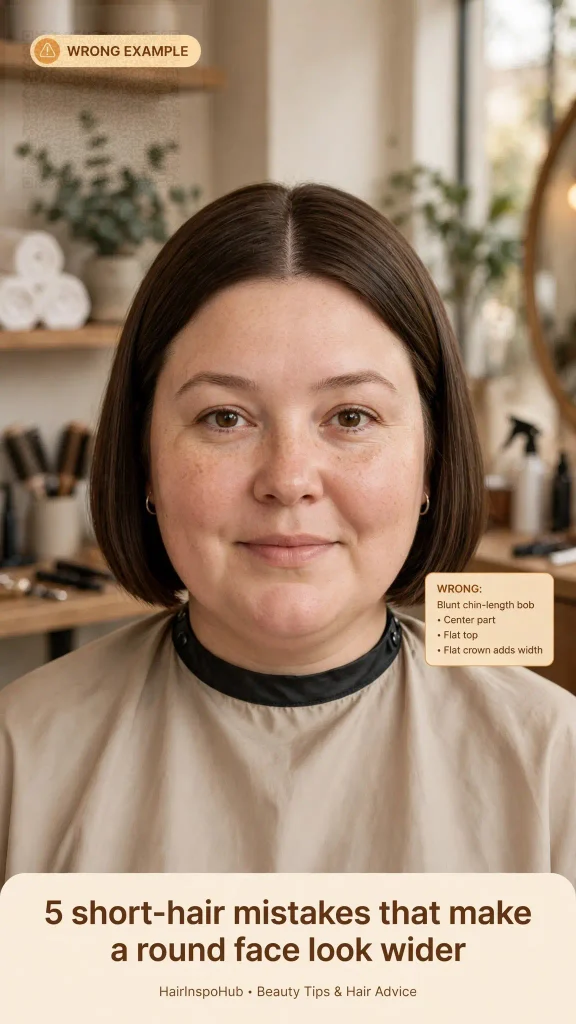
1. The blunt chin-length bob. One straight line ending at the chin or cheek is the most common widening mistake. Fix it by moving the line: angle it below the chin, layer it, or make the ends piece-y (ideas 5, 6 and 14).
2. Flat on top, wide at the sides. This copies the round silhouette exactly. Fix it with crown root lift and smooth, close sides in every blow-dry, whichever cut you wear.
3. A heavy, low, straight fringe. It cuts the forehead off the face and shortens everything. Choose a side-swept or curtain fringe instead (ideas 2, 4 and 9).
4. Layers that end at the cheekbone. Layers draw attention where they end. Ending at the widest point highlights it. Face-framing layers should start below the cheek and fall towards the chin.
5. A centre part on a symmetrical bob. It frames both cheeks equally and underlines the width. A deep side part is a thirty-second fix that changes the whole read of the cut.
What to say at the salon: copy-paste scripts
Screenshot or copy the script for your chosen cut. Each one names the three things that decide success on a round face: where the height goes, where the length ends and where the layers sit.
Script 1: the safe bob
“I have a round face, so I need the front to end below my chin, not at it. Please angle it longer at the front, add light internal layers so it does not sit heavy on my cheeks, and give me a deep side part. No blunt line at my jaw, please.”
Script 2: the pixie
“I want a pixie that makes my face look longer: tapered close sides, textured length on top that I can style up, and a fringe I can sweep diagonally. Keep all the volume at the crown and none over my ears.”
Script 3: if you are nervous
“I am going shorter in stages. Today, take me to a layered lob below my jaw, with face-framing pieces past my chin. If I love it, we will go shorter next time. Please do not take the front shorter than we agreed.”
Also take: two or three photos of your chosen cut (front and side), one photo of what you do not want, and your glasses if you wear them. Show your natural hair texture to the stylist before the wash, not after it has been smoothed.
How to style short hair for a round face at home in 5 minutes
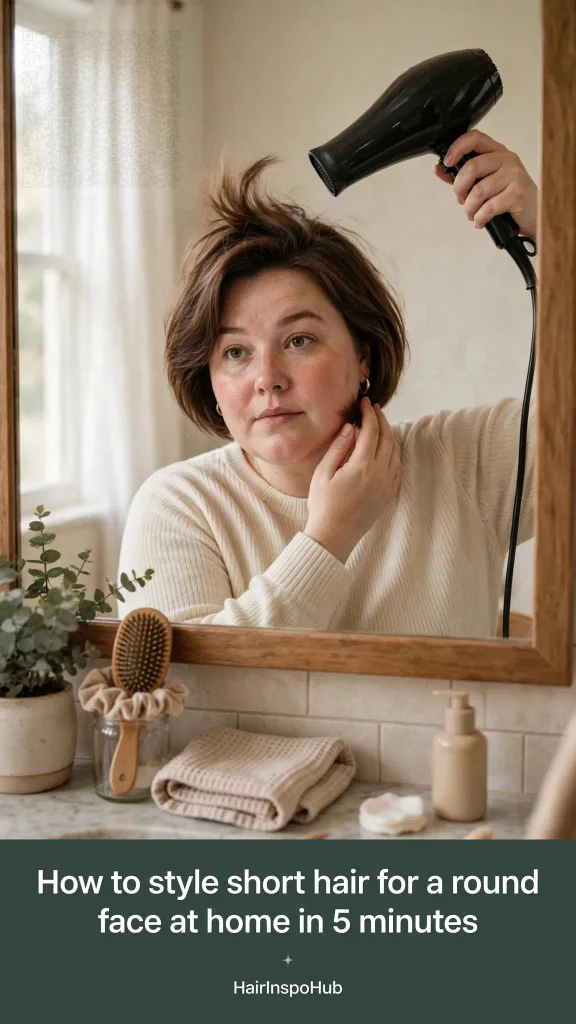
- Apply root product at the crown only. A small amount of volumising mousse or root spray on the crown section of damp hair. Product at the sides works against you.
- Blow-dry the top up first. Use fingers or a small round brush and lift the crown up and slightly back for the first minute. This minute decides the shape of the whole style.
- Dry the sides down and close. Smooth the sides with a flat brush or your palms so they sit against the head. Never blow the sides outwards.
- Add the diagonal. Set your deep side part, sweep the fringe across, and tuck the short side behind the ear if your cut allows it.
- Finish with a pea-sized amount of paste or cream, on the top and ends only. Work it through the crown and front pieces to separate the texture. Keep it off the sides.
On non-wash days, revive only the crown: a mist of water or dry shampoo at the roots, thirty seconds of upward blow-drying, and reset the side part. Do not re-style the whole head.
Maintenance calendar: how often does short hair need a trim?
| Cut family | Salon trim | At-home effort | Grow-out quality |
| Pixie and undercut (1, 3, 12, 17) | Every 3-6 weeks | 3-5 minutes daily | Loses shape fastest; sides grow out first |
| Bixie and pixie-bob (4, 20, 22) | Every 5-8 weeks | 3-5 minutes daily | Soft grow-out; most forgiving pixie family |
| Bobs (5, 7, 8, 11, 13, 14, 16) | Every 6-8 weeks | 5-10 minutes on wash days | Good, if the front length is protected |
| Lob (6) | Every 8-10 weeks | 5 minutes, 2-3 times a week | Best grow-out in this guide |
| Shag and wolf cut (9, 15) | Every 6-9 weeks | Scrunch and go | Meant to look lived-in; very forgiving |
| Curly and natural shapes (10, 18) | Every 4-8 weeks by shape | Moisture routine, diffuser | Shape holds if sides stay close |
Short hair is not automatically high maintenance, but it trades daily length-management for regular trims. Budget for the trim of your chosen family before you commit, and book the next appointment as you leave the salon; a pixie two weeks overdue reads as a different, wider cut.
Before you book: a 2-minute checklist
- I confirmed my face shape with hair pulled back (round, or close enough that round-face rules help).
- I shortlisted two or three cuts using the quick-pick and hair-type tables, not photos alone.
- Each shortlisted cut follows all three rules: crown height, a diagonal, and no ending at my widest point.
- I saved front and side photos, plus one photo of what I do not want.
- I copied the salon script for my cut and know my trim budget from the maintenance calendar.
- If I am nervous, I chose the staged route: lob or long pixie first, shorter next visit.
Frequently asked questions about short hair for round faces
Will short hair make my round face look bigger?
Only if the cut copies the face shape. A short cut that is flat on top and wide at the cheeks will make a round face look bigger. A short cut with crown height, close sides and a diagonal part or fringe makes the face look longer and is often more flattering than long hair hanging straight beside the cheeks, which frames the width on both sides.
What is the single best short hairstyle for a round face?
If one cut must be named, it is the textured pixie with crown height for very short hair, and the angled bob ending below the chin for bob length. Both follow all three rules in this guide. The best cut for you personally is the highest-ranked one that also matches your hair type in the hair-type table.
Can I wear a bob if I have a round face?
Yes, if the bob is adjusted. Choose an angled, layered or piece-y bob that ends below the chin, worn with a side part. Avoid a blunt one-length bob ending exactly at the chin or cheek with a centre part; that version draws a horizontal line at the widest point of the face.
Are bangs a good idea on a round face with short hair?
Side-swept and curtain bangs are good ideas because they add a diagonal or a soft central frame while keeping the forehead partly visible. A heavy, straight, low fringe is the risky version because it shortens the visible face. If you want a fringe, ask for it swept, wispy or split, never a solid straight line.
Which short cut is best for a round face and fine hair?
A feathered layered bob (idea 16) or a bixie (idea 4). Both create lift and movement without removing the density fine ends need. Ask your stylist not to over-thin the layers, and style with light mousse at the crown only.
Which short cut is best for a round face and thick or curly hair?
A short shag (idea 9) for wavy and thick hair, and a curly crop shaped higher on top with closer sides (idea 10) for curls. The shared principle is removing or controlling side volume while keeping height. Straightening is not required for a flattering result.
What short hairstyle suits a round face over 50?
A silver feathered pixie-bob (idea 20) is built for mature hair: crown lift, soft feathered edges and a front below the chin. It flatters a round face while working with grey texture and finer density instead of against them. Keep products light so the crown lift survives the day.
How do I stop my short hair from looking round as it grows out?
Keep the two appointments that matter: a shape trim before the sides reach cheek width, and a tidy of the face-framing pieces if they creep up to the cheekbone. Between appointments, keep styling the volume up, not out; most grow-out roundness is side growth plus flat crown styling, and the styling half is in your control daily.

Stella Mary is a US-based hair care enthusiast and lifestyle writer at HairInspoHub, sharing trend-forward hairstyle tutorials, styling tips, and healthy hair rituals for women of every hair type. Specializing in Pinterest-inspired looks from bridal updos and effortless braids to heatless waves and sleek ponytails. She blends timeless elegance with everyday practicality. Her mission making gorgeous, confidence-boosting hairstyles accessible to everyone, one tutorial at a time.

One Comment